Before he became one of Nigeria’s most powerful military rulers, Sani Abacha was a young Nigerian Army officer who married in his early twenties.
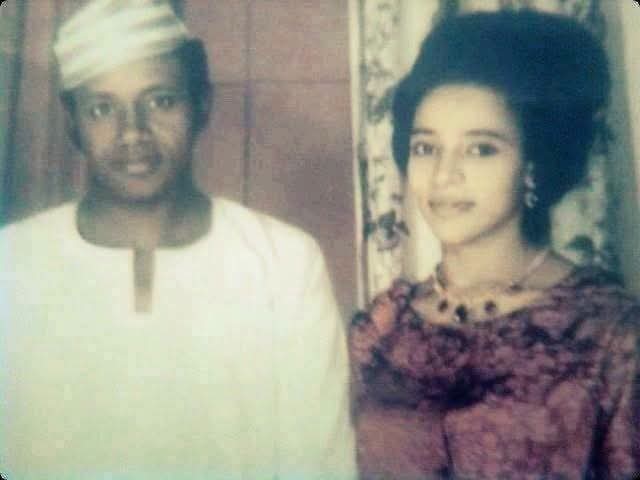
On 20 December 1965, the 22-year-old Abacha married Maryam Jidah, a young woman from Borno State. At the time, Abacha was still at the beginning of a military career that would eventually take him from the ranks of a young officer to the highest political office in Nigeria.
Their marriage would last for more than three decades and remain one of the country’s best-known political families.
A Marriage Before the Power
Sani Abacha was born in 1943 and joined the Nigerian Army after receiving his early military training in Kaduna. He was commissioned into the army in the early 1960s and subsequently underwent further military training in the United Kingdom.
It was during these early years of his military career that he married Maryam.
Maryam Abacha, born Maryam Jidah on 4 March 1947, came from Borno State. Biographical records identify her parents as Mahammad Jidah and Nana Jiddah. She attended schools in Kaduna and Kano before her marriage to the young army officer.
At the time of their wedding, neither could have known how dramatically their lives would change over the following decades.
From Young Officer to Head of State
Abacha’s military career developed rapidly.
He served during the Nigerian Civil War and subsequently occupied a series of increasingly important military positions. By the 1980s and early 1990s, he had become one of the most influential officers in the Nigerian Armed Forces.
In 1993, following the collapse of the Interim National Government headed by Ernest Shonekan, Abacha assumed power and became Nigeria’s military Head of State.
Maryam consequently became First Lady of Nigeria, a position she held from 1993 until Abacha’s death in 1998.
The transformation was remarkable: the young lieutenant who had married Maryam in 1965 had, less than three decades later, become the country’s most powerful political figure.
A Large Family
Sani and Maryam Abacha had a large family.
Reliable biographical records identify ten children — seven sons and three daughters.
One of their sons, Ibrahim Abacha, died tragically in an aircraft crash in January 1996.
Ibrahim, who was 28, was among 14 people killed when a government aircraft crashed near Kano on 17 January 1996. Contemporary reports recorded conflicting theories about the accident. An opposition group claimed responsibility, while aviation officials reported that the pilot had experienced engine problems. No definitive evidence established the more dramatic claims surrounding the crash.
For the Abacha family, the tragedy came at a particularly difficult period in Sani Abacha’s rule.
Maryam Abacha’s Public Role
Although often remembered primarily as the wife of the military ruler, Maryam Abacha developed her own public profile as First Lady.
She launched the Family Support Programme (FSP) in 1994, an initiative focused on women, children and family welfare. The programme later influenced the establishment of the Family Support Trust Fund and was associated with the development of what was originally the National Hospital for Women and Children in Abuja. The hospital was inaugurated in 1999 and later became the National Hospital, Abuja.
She also became involved in initiatives relating to women, education, health and social development.
Her public activities gave her a prominent role beyond the traditional ceremonial expectations often associated with the position of First Lady.
Nearly Three Decades Together
From their wedding in 1965 to Abacha’s death in 1998, Sani and Maryam Abacha remained married for more than three decades.
Their story therefore began long before the military uniforms, official residences and political controversies that later surrounded their names.
It began with a 22-year-old army officer and a young woman from Borno.
Over the next 33 years, they experienced marriage, parenthood, military coups, civil war, political power, national controversy and personal tragedy.
The young officer eventually became Nigeria’s Head of State.
His wife became First Lady.
Together, they raised a large family whose name would remain permanently connected to one of the most controversial periods in Nigeria’s modern history.
Sources
1. National Library of Nigeria, A Portrait of Mrs. Maryam Sani Abacha.
2. Biographical Legacy and Research Foundation, Maryam Sani Abacha.
3. The Guardian Nigeria, “Sani Abacha: 20 Years After”, biographical overview of Abacha’s military career and family.
Credit: Historical Nigerian Stories