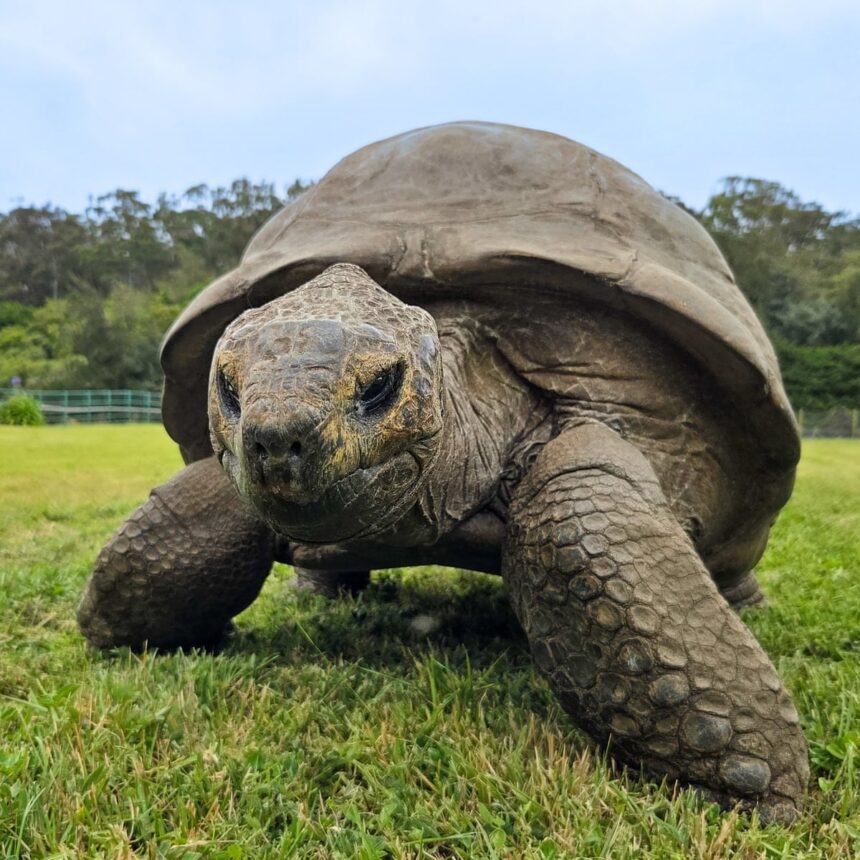
Scientists have uncovered potential genetic clues that may explain the extraordinary longevity of Jonathan, a giant tortoise believed to be about 194 years old and widely recognised as the world’s oldest living land animal.
The findings, published in the journal Science Advances, could deepen scientific understanding of ageing and potentially contribute to future research into treatments aimed at slowing age-related cellular decline in humans.
Jonathan is an Aldabra giant tortoise, a species native to the Seychelles in the Indian Ocean. He has spent most of his life on the remote South Atlantic island of St Helena, a British Overseas Territory.
Although giant tortoises are known for their exceptional longevity, with some living for more than a century, Jonathan’s estimated age places him among the most remarkable examples of long-lived animals.
According to a report by CNN Science, researchers investigated Jonathan’s genome — his complete set of DNA — and epigenome, which regulates how genes are switched on and off, to identify biological mechanisms that may help explain his remarkable lifespan.
The analysis identified 287 gene variants associated with protection against cellular damage, offering possible explanations for how the tortoise has maintained his health well into extreme old age.
Genetic Mechanisms May Hold the Key
Justin Gerlach, a study co-author and biology fellow at the University of Cambridge in the United Kingdom, said scientists have long suspected that the slow metabolism of giant tortoises could contribute to their longevity.
“The assumption has always been that their metabolic rate is very low compared to us,” Gerlach said, as quoted by CNN Science.
He explained that slower metabolic activity could mean fewer chemical reactions inside cells, potentially reducing damage to cells and DNA over time.
However, the researchers’ findings point to additional factors that may contribute to Jonathan’s exceptional lifespan.
According to Gerlach, the tortoise possesses genes associated with DNA repair and the reduction of inflammation, two biological processes linked to the maintenance of cellular health.
The study also suggests that Jonathan may retain the ability to regulate gene activity effectively despite his advanced age.
In humans and many other animals, the systems responsible for controlling cellular functions can become less reliable with age, potentially contributing to cancer and other age-related conditions.
Jonathan, however, appears to have maintained genetic controls associated with a much younger animal, according to Gerlach.
“He does have some genes that are particularly good for DNA repair and reducing inflammation,” he said.
The researcher cautioned that it remains unclear whether these characteristics are unique to Jonathan or are common among giant tortoises.
Nevertheless, the findings suggest that the animals may retain better biological function in old age than scientists would otherwise expect.
Findings Could Advance Human Ageing Research
Scientists have long sought to understand why certain species live significantly longer than others and whether their biological advantages could provide lessons for human health.
Several animals, including certain whales, sharks and clams, are known for their unusually long lifespans. However, the genetic and molecular mechanisms responsible for these differences remain incompletely understood.
Joao Pedro de Magalhaes, chair of molecular biogerontology at the University of Birmingham in the United Kingdom, who was not involved in the research, described the broader significance of investigating longevity across different species.
“Understanding why some species live much longer than others would represent a major breakthrough in our understanding of ageing and longevity, with potential applications to human health,” he said, according to CNN Science.
Researchers hope that studies of exceptionally long-lived animals could eventually help scientists identify biological pathways involved in maintaining cellular health and resisting age-related deterioration.
However, the findings do not mean that treatments capable of extending human lifespan are imminent. Further research would be required to determine whether the mechanisms identified in Jonathan could be applied safely and effectively to humans.
How Old Is Jonathan?
Jonathan’s exact age remains unknown. His estimated age is based on a photograph taken in 1882, which shows him on St Helena already at adult size.
Giant tortoises typically reach adult size at around 50 years of age. Using that estimate, researchers have calculated that Jonathan could be approximately 194 years old in 2026.
His remarkable longevity has made him a subject of international scientific interest, particularly as researchers seek to understand how some animals maintain their health for far longer than most other species.
While the new findings do not fully explain Jonathan’s extraordinary lifespan, they offer further clues into the biological mechanisms that may allow certain animals to resist the effects of ageing.
For scientists, the hope is that understanding these natural defences could eventually open new avenues for research into healthier ageing in humans.
Source: CNN Science