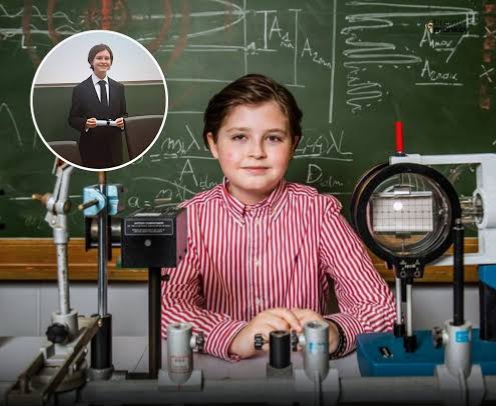
Laurent Simons has become one of the most remarkable young figures in modern science. By the age of 15, the Belgian prodigy had already defended a PhD in quantum physics at the University of Antwerp—an achievement that places him far beyond even the most gifted academic peers. Yet instead of stopping there, Simons has set his sights on an entirely new frontier: medical science. He is now pursuing a second PhD focused on AI-driven biomedicine, with an ambitious long-term goal—extending human lifespan.
What makes Simons’ story especially compelling is not only the speed of his achievements, but the clarity of his purpose. While many child prodigies attract attention for raw intelligence alone, Simons has consistently framed his work around real-world scientific impact. His transition from quantum physics to life sciences reflects a deliberate effort to apply advanced theoretical knowledge to some of humanity’s most pressing biological challenges.
A journey defined by speed, focus, and discipline
Simons’ rapid ascent through academia began early. Teachers quickly realised that traditional classrooms could not keep pace with his learning ability. According to his parents, Alexander and Lydia Simons, educators repeatedly tested him to find the limits of his understanding. Alexander once described his son as “a sponge,” absorbing complex material with extraordinary ease.
Initially, his parents found it difficult to grasp just how exceptional his abilities were. That changed when schools began warning that Laurent’s learning speed was far beyond standard educational frameworks. Rather than chasing publicity, the family focused on finding environments where he could develop intellectually without unnecessary pressure or hype.
That measured approach proved crucial. Instead of becoming a media curiosity, Simons progressed steadily into serious academic research. His teenage PhD in quantum physics—a field notorious for its mathematical and conceptual difficulty—demonstrated not only intelligence, but resilience, discipline, and advanced scientific reasoning.
Turning brilliance toward human longevity
Now, Simons is applying his talents to medical science, particularly the intersection of artificial intelligence and biomedicine. His long-term vision is to contribute to research that can extend human life and improve health outcomes. It’s a shift that reflects maturity beyond his years: moving from abstract theory to research with direct implications for humanity’s future.
Laurent Simons’ journey stands out as one of the most extraordinary academic stories of this generation—not simply because of his age, but because of his intent. By pairing rare intellectual ability with a clear scientific mission, he represents a new kind of prodigy: one focused not on records, but on results.
Credit: The Times of India