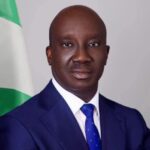
Okoh Ebitu Ukiwe, born on 26 October 1940, stands as one of the more complex and consequential figures in Nigeria’s military and political history. A retired Commodore of the Nigerian Navy, he rose to national prominence when he served as Chief of General Staff under Ibrahim Babangida from 1985 to 1986, a position that effectively made him the country’s second in command during that period.
Ukiwe was born into a distinguished family in Abiriba, in present day Abia State. His father, Chief Ebitu Ukiwe, held significant traditional authority as a ruler in the community and presided over the old Bende Division Local Government Appeal Court. This background placed the young Ukiwe at the intersection of indigenous leadership and colonial administrative structures, an experience that would later shape his worldview.
His military career began in 1960 when he joined the Nigerian Navy as a cadet officer. By 1964, he had earned a commission as a sub lieutenant. However, the political crises that engulfed Nigeria in the mid 1960s altered the trajectory of his service. In 1966, he aligned with the Biafran Armed Forces, and during the Nigerian Civil War he fought on the Biafran side. Following the end of the conflict in 1970, Ukiwe’s reintegration into the Nigerian state marked a significant moment. In January 1972, he was readmitted into the Navy, becoming one of the few Igbo officers to regain his commission after the war.
His post war career advanced steadily. Between 1975 and 1977, he served as a member of the Supreme Military Council, the highest governing body at the time. In 1977, he was appointed military governor of Niger State by Olusegun Obasanjo. A year later, in July 1978, he was transferred to Lagos State, where he served as governor until October 1979. During these years, he demonstrated administrative capability within the framework of military governance.
Ukiwe remained influential within the military hierarchy in the following decade. Under Muhammadu Buhari, he again sat on the Supreme Military Council between 1983 and 1985 while serving as Flag Officer of the Western Naval Command. His earlier roles included Director of the Naval Faculty at Jaji from 1981 to 1984 and subsequent leadership of the Western Naval Command.
The turning point of his national prominence came after the 1985 Nigerian military coup d’état, when Babangida appointed him Chief of General Staff. In this role, Ukiwe functioned as the regime’s principal deputy. His tenure, however, was short lived. In 1986, he was removed from office after opposing Nigeria’s proposed membership in the Organisation of Islamic Cooperation, a decision that revealed both his independence of thought and the limits of dissent within military rule.
After leaving public office, Ukiwe aligned himself with pro democracy movements. He supported Moshood Kashimawo Olawale Abiola following the annulled June 1993 presidential election and remained critical of authoritarian rule during the era of Sani Abacha.
In the private sector, Ukiwe transitioned into business leadership. He chaired several companies including Bitu Properties, Kobimat, Bitu Promar, and Rudocons. He also served as an adviser and consultant to Statoil in Nigeria for nearly a decade, particularly in offshore oil operations.
His name resurfaced in political discussions in the early 2000s. In 2001, Newswatch magazine described him as a principled figure with presidential potential. He later sought the presidential nomination of the Peoples Democratic Party in 2006, though his bid was unsuccessful.
In more recent years, Ukiwe has remained an engaged public voice. He has been associated with the Nigerian Indigenous Nationalities Alliance for Self Determination, contributing to debates on federalism, national equity, and the evolving nature of Nigeria’s union in the face of regional and ideological tensions.
Taken together, Ukiwe’s life reflects the broader story of Nigeria itself, shaped by war, reconciliation, military rule, and the continuing search for democratic balance.
Credit: North Book, Historical Nigeria-Yoruba