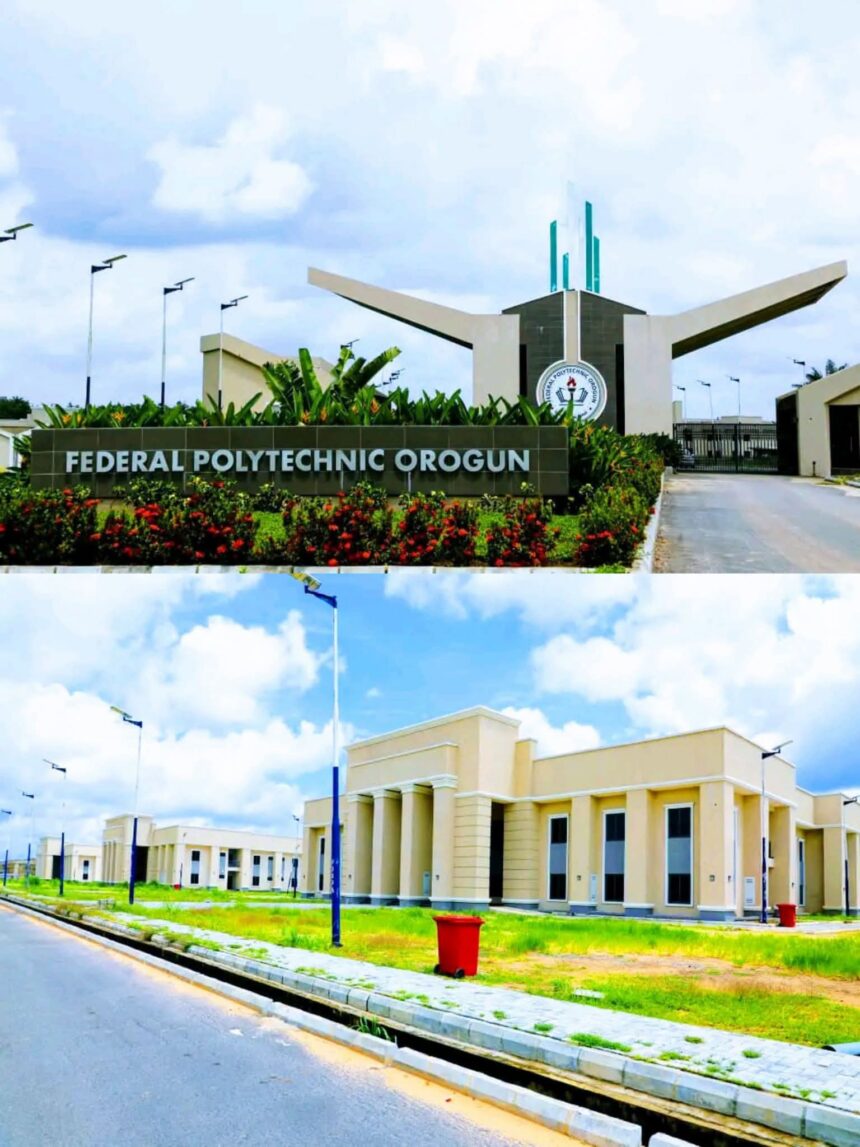
ASABA — The Delta State Government’s decision to establish a campus of the Federal Polytechnic, Orogun, in Omadino has sparked heated reactions, with stakeholders divided over the legality, funding and rationale behind the move.
While some residents and education stakeholders have welcomed the proposed campus, describing it as an opportunity to expand access to tertiary education, others have questioned why a relatively young federal institution should be extended to another location.
Some critics also argued that the state government should instead seek the establishment of new tertiary institutions in areas that do not have federal or state-owned polytechnics.
One commentator questioned the authority of the state government to establish a campus of a federal institution, asking whether the Federal Ministry of Education and relevant regulatory authorities had approved the arrangement.
Another contributor argued that the Federal Polytechnic, Orogun, was a product of efforts by stakeholders from Delta Central Senatorial District and should not be divided among senatorial districts.
“If at all there’s a need for satellite campuses from Orogun Federal Polytechnic, it should be Ewu-Urhobo in Ughelli South, Delta Central,” the contributor stated.
Concerns were also raised over the proposed campus’s ownership, staffing and funding arrangements. Stakeholders asked whether newly recruited workers would be employees of the federal or state government and whether the project would be jointly funded.
However, others defended the initiative, saying federal institutions could operate satellite campuses through collaborations with state governments, including arrangements involving shared facilities, memoranda of understanding and other forms of intergovernmental cooperation.
A supporter of the proposal described the establishment of a Federal Polytechnic campus in Omadino as “a welcome development,” arguing that the initiative would improve access to higher education in the area.
Some contributors, however, expressed reservations about the need to establish another campus when the Federal Polytechnic, Orogun, is still relatively new and has substantial land for future expansion.
Others questioned why the state government did not extend existing state-owned institutions to Omadino instead, citing institutions such as Delta State University and other polytechnics in the state.
The proposal has also generated ethnic and political undertones, with some commentators alleging that the decision was influenced by political considerations and concerns over the distribution of tertiary institutions across Delta State’s senatorial districts.
One contributor suggested that the Itsekiri people would have preferred the establishment or extension of institutions such as the Petroleum Training Institute or the Federal University of Petroleum Resources, Effurun, rather than the proposed Federal Polytechnic campus.
As the debate continues, stakeholders are seeking greater clarification from the Delta State Government and relevant federal authorities on the legal framework, ownership, governance, accreditation, funding and staffing of the proposed Omadino campus.
The controversy is expected to persist until the details of the arrangement between the state government and the Federal Polytechnic, Orogun, including any approval or collaboration agreement with the Federal Government, are made public.