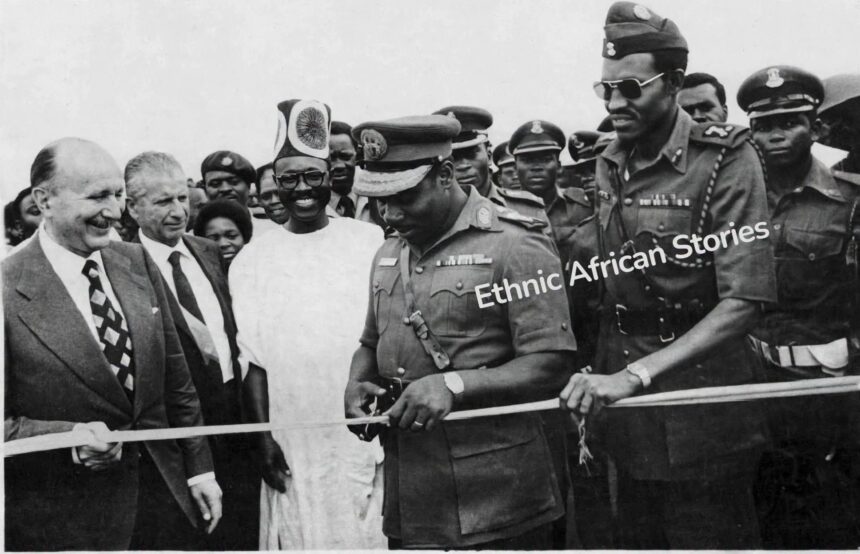
WARRI — What was once celebrated as a landmark of Nigeria’s emerging oil industry has, decades later, become a symbol of the country’s troubled refining story.
A historical account shared by Ethnic African Stories has resurfaced images from the commissioning of the Warri Refinery in 1978, showing then Head of State, General Olusegun Obasanjo, formally inaugurating the facility.
The refinery, located at Ekpan, near Warri in Delta State, was commissioned in September 1978, having been completed earlier that year. Historical records show that it was designed initially to process 100,000 barrels of crude oil per day, making it a major addition to Nigeria’s refining capacity at the time.
At the time of its commissioning, the then Chairman of the Nigerian National Petroleum Corporation (NNPC), Brigadier Muhammadu Buhari, reportedly highlighted the refinery’s economic importance and its potential to generate significant revenue for the country.
Buhari, who had previously served as Governor of the former North-Eastern State, was also Federal Commissioner for Petroleum and Natural Resources during the period when the refinery project was being developed.
The Warri project was conceived as a major step towards reducing Nigeria’s dependence on imported petroleum products and meeting the country’s growing domestic energy needs. It was a complex conversion refinery designed to produce products including gasoline, kerosene, diesel and fuel oil.
The facility was later de-bottlenecked to 125,000 barrels per day in 1987, further increasing its potential contribution to the national economy.
However, the optimism surrounding the refinery’s commissioning has over the years given way to a much more troubling reality. The facility has experienced prolonged periods of poor performance, repeated maintenance challenges and costly rehabilitation efforts, contributing to concerns over the management of Nigeria’s government-owned refineries.
The contrast is striking: a facility once commissioned with expectations of strengthening Nigeria’s energy security and generating substantial economic returns has spent much of its later history struggling to operate at anything close to its original potential.
Nearly five decades after the historic commissioning, the Warri Refinery remains a powerful reminder of both Nigeria’s early ambitions in petroleum refining and the enormous challenges that have confronted the country’s downstream oil sector.
Credit :Ethnic African Stories, Historical stories