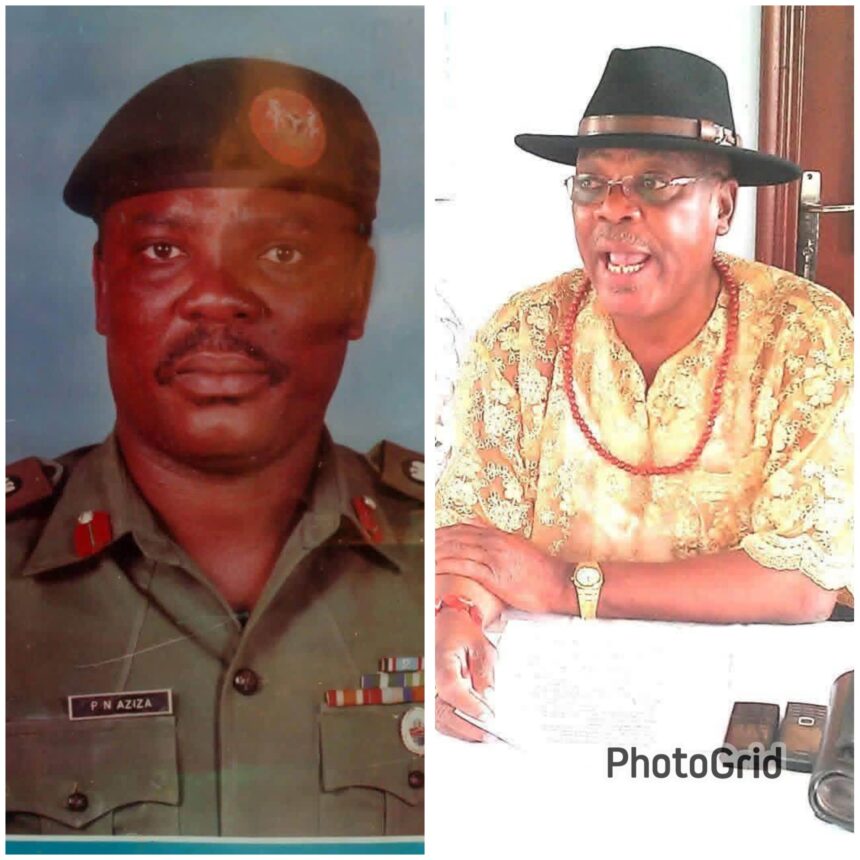
By Urhobo House
Major General Patrick Newton Aziza (23 December 1947 – 16 August 2014) was a distinguished Nigerian military officer, statesman, administrator, federal minister, and one of the prominent voices in the modern history of the Urhobo nation. A proud son of Okpe Kingdom in present-day Delta State, Aziza distinguished himself through decades of military service and public administration before emerging as an influential advocate for Urhobo unity, political relevance, cultural identity, and collective advancement. His life represented a remarkable intersection of military professionalism, national service, traditional responsibility, and an enduring commitment to the aspirations of his people.
Born on 23 December 1947 in Okpe Local Government Area of present-day Delta State, Aziza’s roots were firmly embedded in the rich cultural heritage and traditions of the Urhobo people. Although he spent his formative years in Abakaliki, in present-day Ebonyi State, he maintained his connection to his ancestral homeland. He later relocated to Ibadan in southwestern Nigeria, where he completed his secondary education. His early exposure to different parts of the country provided him with a broad understanding of Nigeria’s cultural diversity and helped shape the outlook of a man who would eventually serve both his country and his ethnic nationality in positions of considerable responsibility.
Following the outbreak of the Nigerian Civil War in 1967, Aziza joined the Nigerian Army and participated in the conflict, which ended in 1970. Thereafter, he formalised his military education at the Nigerian Defence Academy in Kaduna, graduating in 1970. He was commissioned as a Second Lieutenant that year and subsequently promoted to Lieutenant before being posted to the renowned 3rd Marine Commando Division. In 1971, he attained the rank of Captain and was appointed Aide-de-Camp (ADC) to the then Chief of Army Staff, Major General David Ejoor, himself a distinguished son of Urhobo land.
In 1974, Aziza travelled to the United States for a twelve-month professional course at the Advanced School of Infantry, Fort Benning, Georgia. On his return to Nigeria, he held several important military appointments, including commanding a battalion in Warri and serving as Brigade Major in Kano. He further advanced his professional military education at the Command and Staff College, Jaji, between 1978 and 1979. He subsequently served at Army Headquarters, where he was involved in troop movement, operational planning, and the coordination of Nigeria’s international peacekeeping commitments. These included Nigerian deployments to the United Nations Interim Force in Lebanon (UNIFIL) and service with the United Nations Iran-Iraq Military Observer Group.
Aziza’s distinguished military career eventually led him into the arena of national political administration. While serving as Brigade Commander of the Amphibious Brigade in Calabar, he was appointed by the administration of General Ibrahim Babangida as the first Military Administrator of the newly created Kebbi State. He assumed office on 28 August 1991 and served until January 1992, overseeing the establishment of the administrative structures and foundational institutions of the new state before handing over to the elected civilian governor, Abubakar Musa.
He subsequently became a member of the Provisional Ruling Council and occupied influential positions during the military administration of General Sani Abacha. In 1995, he was appointed Chairman of the Special Military Tribunal established to investigate an alleged coup plot against the government. The tribunal handed down controversial convictions involving prominent Nigerians, including former Head of State Olusegun Obasanjo and Major General Shehu Musa Yar’Adua, as well as six journalists accused of treason.
Following his service as tribunal chairman, Aziza was appointed Minister of Communications in the Abacha administration. During his tenure, he undertook measures aimed at restructuring the telecommunications sector, including the revocation of several telecommunications licences and efforts to address the country’s deteriorating telephone infrastructure. In August 1998, under the transitional administration of General Abdulsalami Abubakar, he was appointed Minister of Commerce and Tourism, a position he held until the restoration of democratic civilian rule in May 1999.
With the inauguration of President Olusegun Obasanjo in June 1999, Aziza was retired from the Nigerian Army alongside other military officers who had participated in political appointments during military rule. In October 2000, he appeared before the Human Rights Violations Investigation Commission, popularly known as the Oputa Panel, in Abuja, where he addressed questions concerning the controversial 1995 coup trials. He firmly denied allegations that he had ordered the torture of detainees. In July 2001, he also faced administrative scrutiny following a federal commission’s investigation into the management of cocoa export funds during his tenure as Minister of Commerce and Tourism.
Beyond his military and political accomplishments, however, Major General Aziza’s most enduring contribution to his people was his commitment to the Urhobo cause. Having attained considerable national prominence, he brought his experience, influence, and leadership capacity to bear on the affairs of his ancestral homeland. He understood that the progress of the Urhobo nation required more than cultural pride; it demanded unity, purposeful leadership, political participation, institutional strength, and a collective determination to protect the interests of the people.
His emergence as President-General of the Urhobo Progress Union (UPU), the foremost socio-cultural organisation of the Urhobo people, marked a defining chapter in his public life. At the helm of the organisation, Aziza assumed the responsibility of providing leadership to a people with a rich history, a distinct cultural identity, and legitimate aspirations for greater recognition and representation within the Nigerian federation. He sought to strengthen the UPU as a rallying point for Urhobo unity and a platform through which the collective interests of the Urhobo nation could be articulated and advanced.
His leadership was particularly significant at a time when questions of political representation, ethnic cohesion, resource control, and the place of the Urhobo people in the affairs of Delta State and Nigeria remained important concerns. Aziza championed the need for Urhobo political consciousness and solidarity, consistently emphasising that the people could only secure their rightful place in the national political landscape through unity of purpose and collective action.
Among the initiatives associated with his leadership was the Uviamughe Declaration, through which he sought to advance political cohesion and strengthen the Urhobo people’s voice in the affairs of Delta State and the country. His advocacy reflected his conviction that the Urhobo nation must remain actively engaged in the political processes and decisions that shaped its future. He believed that the strength of a people lay not merely in their historical achievements or numerical presence, but also in their ability to speak with a common voice, defend their legitimate interests, and provide purposeful leadership for succeeding generations.
Aziza’s traditional standing further reinforced his connection to the cultural and institutional life of Urhobo land. He was honoured with the titles of Azizokpe of Okpe Kingdom and Ajaguna of Okukuland, recognitions of his standing and contributions within the traditional community. He also received the national honour of Commander of the Order of the Federal Republic (CFR), acknowledging his service to Nigeria. An accomplished amateur golfer, he chaired the Peemos Group after retiring from active military service, applying his experience in administration and logistics to business interests spanning maritime security, oil and gas services, and telecommunications consultancy.
For Major General Aziza, his commitment to the Urhobo nation represented an important continuation of a lifetime devoted to leadership and public service. Having served Nigeria at the highest levels of military and political authority, he brought his experience, influence, and leadership capacity to bear on the advancement of his ancestral homeland. His tenure as President-General of the Urhobo Progress Union reflected his conviction that the future of the Urhobo people depended on unity, purposeful leadership, political participation, and the preservation of their cultural identity. He remained a prominent advocate for the collective interests of the Urhobo nation, particularly its rightful place in the political affairs of Delta State and Nigeria.
After a prolonged battle with cancer, Major General Patrick Newton Aziza joined his ancestors on 16 August 2014 in Abuja, at the age of 66. His passing was deeply felt across Nigeria, particularly within the military, political, traditional, and Urhobo communities. He left behind a legacy that transcended his military achievements and public appointments. He will be remembered as a distinguished military officer, a former state administrator and federal minister, a respected traditional figure, and, above all, a proud son of Urhobo land who devoted a significant chapter of his life to the unity, political advancement, dignity, and collective aspirations of his people. His place in the contemporary history of the Urhobo nation remains an enduring reminder of the responsibility of accomplished individuals to translate personal achievements into meaningful service to their ancestral homeland.