The 2027 governorship battle is on!
The candidacies of Great Ogboru (ADC), Peter Mrakpor (PDP) and Chris Iyovwaye (NDC) among others are neither anathema nor taboo. The 1999 Constitution (as amended) guarantees their democratic rights. But in this context, individual ambition, is an implausible ambush.
No single ethnic group in Delta can govern the state for three consecutive terms or more. No matter the competence, intelligence or pedigree of its son or daughter.
The watershed year, 1999, reconfigured Delta politics, with profound implications.
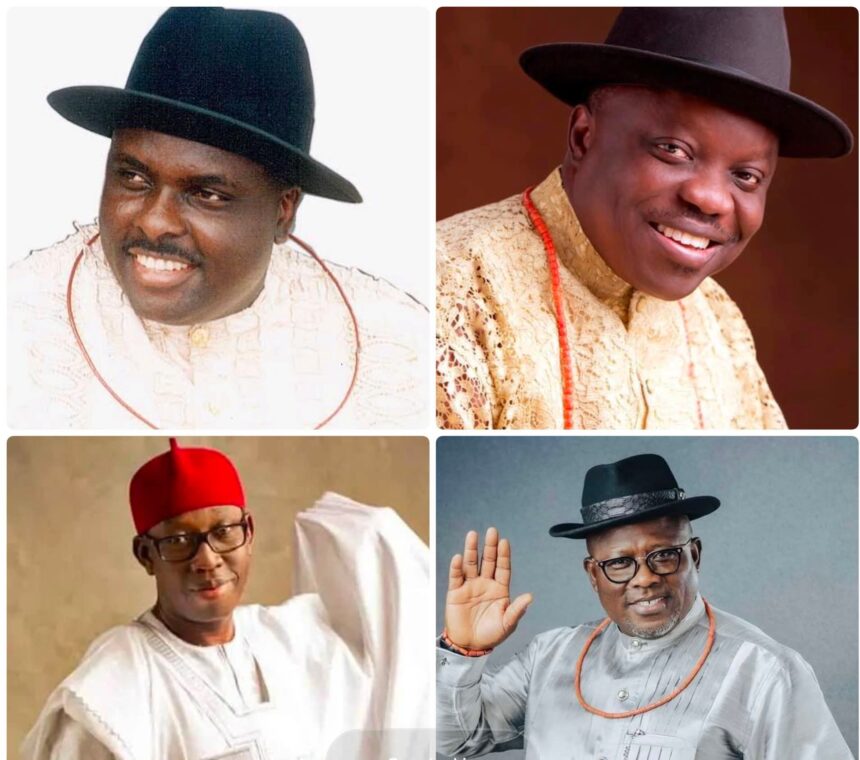
Chief James Onanefe Ibori, (Urhobo), entered the governorship seat in 1999 and ruled for eight years. Dr. Emmanuel Eweta Uduaghan, (Itsekiri),governed for eight years (2007–2015). Dr. Ifeanyi Arthur Okowa,(Ibo), administered the state for eight years (2015–2023). Today, Rt. Hon. Sheriff Oborevwori,(Urhobo), has been on the saddle since 2023.
He is seeking re-election in 2027, primed, hopefully to leave office in 2031.
Does Sheriff deserve the rotational parity of an eight-year tenure, like Ibori, Uduaghan and Okowa?
The question has simple immediate answers. Even for the most naive respondent on the iconic hot seat of NTA’s Tony Iredia or CNN’s Christiane Amanpour.
Power rotation makes Oborevwori’s 2027 chances unassailable.
An unwritten yet potent political pact, presumably formulated since 1999 under Ibori, has helped to peacefully devolve the governorship office among Delta’s three senatorial districts.
Without power sharing, Delta could tether to anarchy. Ethnically conscious and politically volatile, the state is emotive, complex and fiercely competitive in its composition.
Whether by human design or divine unction, the 1999 template of rotational governance saved Delta.
Otherwise, the state could have imploded. The enormity of such an implosion may be difficult to define, but the consequences could be potentially grave, taking Delta down a dangerous road of ethnic conflagration and political instability. While it may not resemble the road to Rwanda or Kosovo as a hyperbolic pessimist could paint, the political confrontation has the tendency to destabilize the delicate equilibrium among the state’s three political blocs.
Oborevwori’s re-election, therefore, is the surest and strongest recipe for political stability and social cohesion in multi-ethnic Delta. This is not the rhetoric of a communication bully; it is the logic of sound reason.
Will any of the Urhobo-born opposition governorship candidates pledge to govern for only four years?
If the response is in the affirmative, call it yahoo!
Who spits away honey when it touches the lips?
While constitutional liberty is permissible, quest for power in a plural society like Delta must never lose sight of mutual restraint and ethnic accommodation.
Imagine one senatorial district, Delta central, holding the governorship for twelve consecutive years or more. Did any other come to count illusive stars on the skies of Asaba, Warri, Ughelli, Oleh or Gbaramatu?
Again, a second term for Oborevwori is analogous to merit. As governor, he has proved responsible and reasonable. His policies and programmes are developing and uniting Delta. Though public expectations remain high, given Africa’s gross underdevelopment matrix, Delta can safely be described as a work in progress.
Curiously, ahead of 2027, the majority of Oborevwori’s challengers, both serious and frivolous contenders, are his Urhobo compatriots.
They should take a cue from the Delta North experience in the 2019 governorship election. The Anioma agenda, which crowned Okowa’s political confidence, was neither divisive nor apologetic. It was total, patriotic and uncompromising.
Even the local political opposition in Delta North against the collective Anioma solidarity for Okowa was, in retrospect, an insignificant comedy.
It was like a lone tiny canoe attempting to reverse the mighty current of River Niger. Silly suicide!
2027!
Anioma (Delta North) is for Oborevwori.
Delta South, predominantly Itsekiri, Ijaw and Isoko, is with Oborevwori.
Delta Central (Urhobo) should not merely join the bandwagon. They have a filial duty to lead the march. This is for the greatest interests of Delta unity and oneness.
The harshest critic may accuse Oborevwori of not flying in governance. (He is not even an aeroplane! 😀)
But many are convinced that he is walking briskly, working. His footsteps so far are good.
He is preserving the Urhobo name, identity and essence proudly.
Above all, he is living his promise:
Governor of all Deltans.
Norbert Chiazor, PhD
26 August 2026