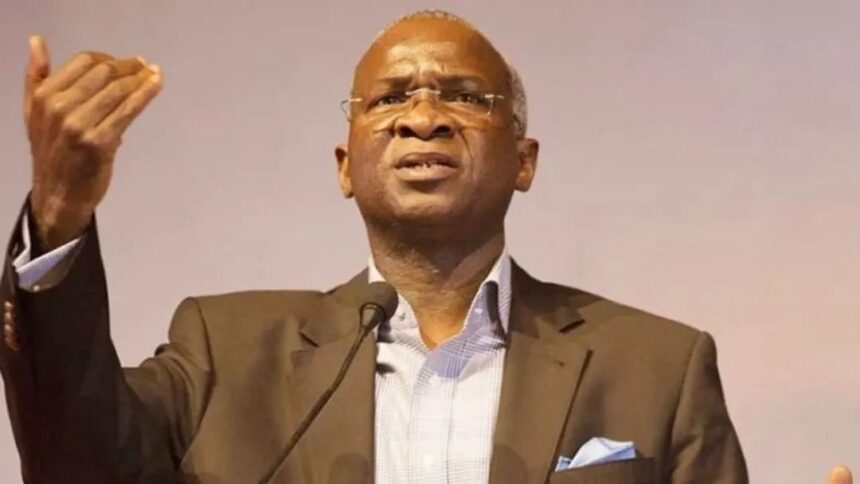
Former Minister of Works and Housing, Babatunde Fashola, has defended President Bola Tinubu’s electricity performance, urging Nigerians to assess the administration’s delivery based on their individual experiences with power supply and access to prepaid meters.
Fashola made the remarks during an interview on Channels Television on Tuesday night, while reacting to renewed scrutiny of Tinubu’s 2023 campaign promise to improve electricity supply and end estimated billing.
During the interview, the presenter played a campaign recording in which Tinubu challenged Nigerians not to re-elect him if he failed to fulfil his electricity pledge.
In the recording, Tinubu had told voters: “You must have electricity. And you will not pay for estimated bills anymore. A promise made, will be a promise kept. If I couldn’t keep the promise and you and I come back for second term, don’t vote for me.”
However, Fashola, who said he was present when Tinubu made the declaration, faulted the presenter for not playing the recording to the end, insisting that the President had included a qualification to his promise.
“First of all, I think you should have let the tape run completely. Because he then said, ‘Unless I give you adequate reasons,’ and you shut it down,” Fashola said.
The former Lagos State governor explained that Tinubu’s pledge had two major components: improving electricity supply and ending estimated billing.
According to him, Nigerians who no longer pay estimated bills because they have received meters, as well as those experiencing improved electricity supply, could reasonably consider the President to have fulfilled his promise in those areas.
“For those who are not paying estimated billing again, they will say promise kept and they will vote for him. For those whose electricity has improved, where it has improved, they will vote for him,” he stated.
Fashola, however, acknowledged that Nigerians who had yet to experience improvements in electricity supply were entitled to demand explanations from the President.
He suggested that Tinubu could seek more time to complete the process, possibly by appealing to voters for another term.
“Perhaps they are entitled to now ask Mr President, maybe you should give us the caveat. What are the reasons why you haven’t reached the end of your journey? And perhaps the reason is that I just need more time. Give me this second term, let me close on my promise,” he added.
The former minister also disagreed with the interviewer’s interpretation that Tinubu had specifically promised Nigerians 24-hour electricity, insisting that such a commitment was not contained in the campaign recording.
“He said adequate. We can replay it again. Replay it. I didn’t hear 24,” Fashola said.
Even after the recording was played again, he maintained that the assessment should focus on whether there had been measurable improvements in electricity supply and access to meters.
“Everybody wants electricity all day. Okay, everybody wants that. I am not going to be avoiding very clear issues. But has it improved in some cases? If it has, those voters will say that this man is true to his word,” he said.
Tinubu made the electricity pledge in December 2022 during a meeting with members of the Organised Private Sector in Lagos, ahead of the 2023 presidential election.
The promise has come under renewed public scrutiny in November 2026 following comments by the APC Presidential Campaign Council spokesperson, Dele Alake, who argued that critics had been quoting Tinubu’s remarks without including his concluding qualification that he would provide adequate reasons if he failed to deliver.
Fashola’s comments have now added another dimension to the debate over the President’s electricity promise, particularly whether partial improvements in power supply and metering can be regarded as fulfilment of a campaign commitment.