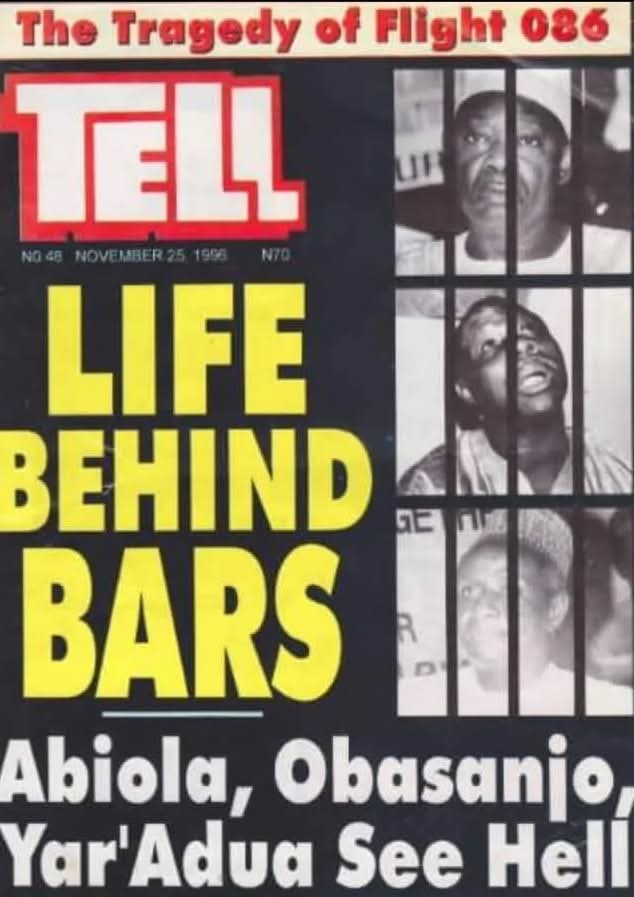
The November 25, 1996 edition of TELL magazine (No. 48) stands today as a chilling historical document of one of Nigeria’s darkest political chapters—the era of General Sani Abacha’s military dictatorship. With the bold cover headline “LIFE BEHIND BARS,” the magazine exposed the harsh detention conditions of some of Nigeria’s most prominent political figures: Chief Moshood Kashimawo Olawale (M.K.O.) Abiola, Chief Olusegun Obasanjo, and General Shehu Musa Yar’Adua.
By late 1996, Nigeria was deep in political paralysis. The June 12, 1993 presidential election, widely regarded as the freest and fairest in the nation’s history, had been annulled. Its presumed winner, M.K.O. Abiola, was arrested in 1994 after declaring himself president, a move that directly challenged the legitimacy of the military regime. By the time TELL went to press in November 1996, Abiola had spent over two years in solitary confinement, denied basic freedoms and regular access to family and medical care.
Also behind bars was Olusegun Obasanjo, a former military Head of State (1976–1979), who was arrested in 1995 and later convicted on allegations of involvement in a phantom coup plot. Many observers—both local and international—viewed his imprisonment as politically motivated, aimed at neutralizing influential figures capable of mobilizing opposition against the regime.
Equally tragic was the detention of General Shehu Musa Yar’Adua, former Chief of Staff, Supreme Headquarters, and a central figure in Nigeria’s political transition debates. Like Obasanjo, Yar’Adua was swept into the regime’s dragnet following the alleged coup plot of 1995. His health deteriorated rapidly in custody, reflecting the brutal conditions TELL courageously documented.
The Abacha regime ruled through fear, decrees, and repression. Independent media houses like TELL operated under constant threat—journalists were harassed, editions were seized, and editors were forced underground. Publishing such a cover story in 1996 was not just journalism; it was an act of defiance.
“Life Behind Bars” went beyond reporting detention—it humanized political prisoners, exposed the moral bankruptcy of military rule, and amplified the voices the state sought to silence. The issue resonated deeply with Nigerians at home and in the diaspora, reinforcing growing international pressure that eventually isolated the Abacha government.
In hindsight, the irony of history looms large. Obasanjo would later emerge from prison to become Nigeria’s civilian president in 1999, while Yar’Adua’s legacy would continue through his brother, Umaru Musa Yar’Adua, who also became president in 2007. Abiola, tragically, did not live to see the democracy his struggle symbolized.
The November 25, 1996 TELL cover remains a powerful reminder of a time when Nigeria’s future was contested in prison cells—and when fearless journalism kept the flame of democracy alive.
Credit: Historical Nigeria-Yoruba