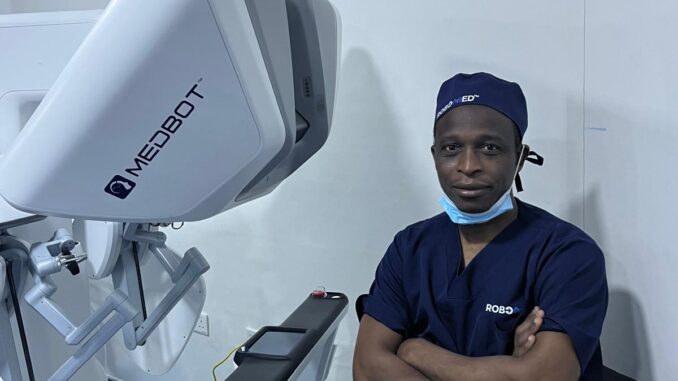
Nigeria has recorded its first tele-robotic surgery following a successful remote kidney operation performed through a collaboration between Redeemer’s Health Village (RHV), RoboMed Global and Nisa Premier Hospital, Abuja.
The groundbreaking procedure, which was carried out on Saturday, involved a surgeon operating in real time from a Toumai robotic console at RHV on a patient at Nisa Premier Hospital in Abuja.
The operation was a telesurgery-assisted, robot-assisted right radical nephrectomy, a procedure performed to remove a kidney affected by a cancerous tumour.
Tele-robotic surgery, also known as remote surgery, enables a surgeon to perform an operation on a patient from a different physical location using advanced robotic and telecommunications technology.
Speaking after the procedure at RHV, Prof. Obi Ekwenna-Davis, Professor of Urology and Transplantation and Co-Founder of RoboMed Global, said the successful operation demonstrated that telesurgery could be safely performed across different locations in Nigeria and beyond.
“Distance should never decide who receives safe surgery; this is what safe and trusted surgery looks like,” Ekwenna-Davis said.
The U.S.-based surgeon said the patient was in good condition following the approximately three-hour procedure and was expected to be discharged within 24 hours.
According to him, the operation included brief stoppages to allow the medical team to confirm that the equipment and systems were functioning properly.
Ekwenna-Davis described the collaboration between RHV and Nisa Premier Hospital as significant, noting that it marked the first time two hospitals in different parts of Nigeria had successfully collaborated to provide surgical care to a patient through tele-robotic technology.
He said the long-term sustainability of the initiative would depend largely on continuous training and capacity building for medical professionals.
To support this, Ekwenna-Davis announced plans to establish a robotic academy aimed at training surgeons and other healthcare professionals in robotic surgery.
He said the academy plans to train at least 150 surgeons within the next two years.
Ekwenna-Davis also disclosed that the programme had received the support of the Minister of Health and other government institutions, while calling for additional backing from private organisations and non-governmental organisations.
The successful procedure marks a new development in Nigeria’s adoption of advanced surgical technology and could expand access to specialised surgical care for patients who may otherwise face geographical barriers to accessing highly specialised surgeons.