By Dr.Ebojele Akhere Patrick
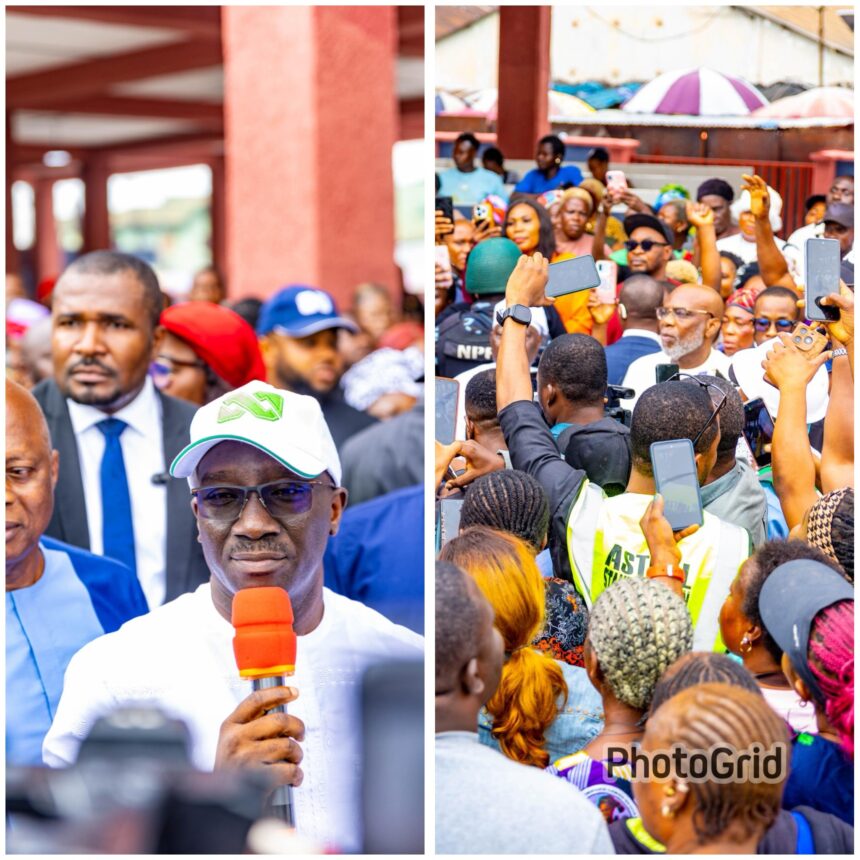
Globally, citizens respond positively when leaders show up, listen, and follow through on commitments. The reason is that public trust is built not only through speeches by these leaders but also through visible action and responsiveness. That is the deeper message from the recent visit of Edo State Governor, Senator, Monday Okpebholo, to the reconstructed Oba Market in Benin City. Beyond the open display of excitement, the songs and the cheers from traders, the visit reflected something many Nigerians from the state are becoming unaccustomed to — the fulfillment of a promise.
For years, the story of Oba Market was one of pain, uncertainty, and disruption. Large sections of the market were destroyed by a fire that did more than destroy buildings and goods. It demoralised citizens, interrupted livelihoods, displaced traders, and created economic hardship for families that had depended on the market for generations. Many traders who once operated comfortably within the walls of the market were forced into temporary spaces, at the merge of rain and sun, and even miscreats struggling to make a living daily with poor conditions.
When Governor Okpebholo promised to reconstruct the market, many traders had misgivings. Like many victims of public disasters, several of them feared the reconstruction might become another abandoned government promise. There are countless examples of markets, roads, and public facilities left incomplete years after official announcements and groundbreaking ceremonies. This has created deep skepticism among citizens who often hear political assurances but rarely witness full delivery.
That is why the reconstruction of Oba Market at record time carries significance beyond physical infrastructure. For the traders and business owners who gathered during Governor Okpebholo’s inspection visit, the completed sections of the market represented proof that the government could still deliver on commitments.
One of the most important aspects of the Governor’s visit was its tone and timing. According to the governor, he decided to inspect the market after seeing reports and complaints from traders who were worried about unfinished sections and the lack of adequate spaces for some displaced business owners. Rather than ignoring those concerns or relying solely on official briefings, he chose to visit personally and engage directly with those affected.
Citizens often judge leaders not only by the projects they complete but also by how they respond when problems arise. Public confidence grows when leaders demonstrate willingness to listen and take responsibility. By acknowledging the concerns of traders publicly and outlining immediate steps to address them, Governor Okpebholo projected an image of accessibility and responsiveness that many citizens desire from public office holders.
The Governor’s assurance that traders operating outside the market would be accommodated within the completed sections also addressed one of the major anxieties surrounding the reconstruction. Markets are highly competitive environments where space determines visibility, customer access, and daily income. For displaced traders, uncertainty over allocation and relocation often creates tension and fear of exclusion.
Perhaps the most widely celebrated announcement during the visit was the Governor’s statement that shops would be allocated free of charge to genuine traders and former occupants. In Nigeria’s difficult economic environment, where inflation and business costs continue to rise, the removal of financial barriers to re-entry into the market was widely seen as a major relief.
For many small-scale traders, market stalls are not simply business spaces; they are the foundation of family survival. Daily earnings from petty trading support school fees, rent, feeding, and healthcare for thousands of households. Requiring heavy payments for shop allocation after years of displacement would have placed additional pressure on already struggling traders. By promising free allocation, the administration positioned the reconstruction not merely as a commercial project but as a social and economic intervention.
The quality and scale of the reconstructed market also became a major point of discussion during the inspection. Former State Deputy Governor Dr Pius Odubu described the facility as comparable to modern markets seen internationally, including those in Dubai. While such comparisons may appear symbolic, they reflect an important issue in public infrastructure delivery — the expectation of quality.
As it were, many Nigerians have grown accustomed to poorly executing public projects that deteriorate shortly after completion. Markets in several states continue to suffer from overcrowding, weak structural standards, inadequate drainage, and poor fire safety systems. As a result, traders often work under unsafe and uncomfortable conditions.
The Oba Market reconstruction will change that narrative. Modern stalls, improved organisation, better protection from environmental conditions, and enhanced trading spaces all suggest an effort to create a more sustainable commercial environment. Beyond aesthetics, these improvements have practical implications for economic productivity and public safety.
Former Deputy Governor Lucky Imasuen also highlighted the importance of creating a safer and more comfortable environment for traders. His remarks reflected a broader understanding that infrastructure is not only about physical structures but also about the dignity of citizens who use them.
In many ways, markets represent the heartbeat of urban economic life in Nigeria. They are centres of commerce, employment, and social interaction. When markets function effectively, local economies become more stable. When they decline, the effects are felt immediately by ordinary citizens.
This is particularly important in a state like Edo, where trading remains one of the major sources of livelihood for thousands of residents. Supporting market infrastructure, therefore, goes beyond beautification; it is an investment in economic resilience and social stability.
Another notable aspect of the Oba Market inspection was the visible support expressed by political figures from different administrations and backgrounds. Alongside Governor Okpebholo besides two former Deputy Governors Pius Odubu and Lucky Imasuen was former Senator Mathew Urhoghide and other political leaders.
In Nigeria’s political environment, where public projects are often viewed through partisan lenses, such open commendation from former office holders is significant. It suggests that the impact of the reconstruction was visible enough to transcend political divisions.
Mathew Urhoghide’s comments during the visit also reflected the emotional importance of the project. He described the reconstruction as a restoration of pride and life to Oba Market. That observation captures an often overlooked dimension of public infrastructure — its psychological and social value.
For traders who lost shops, goods, and business opportunities after the fire incident, the rebuilding process was about more than returning to commerce. It was about regaining stability, identity, and confidence in the future. Markets are deeply woven into the social fabric of communities. Families build reputations, relationships, and livelihoods around them over decades.
When those spaces are destroyed, the impact extends far beyond economics. Communities lose gathering spaces, long-standing customer relationships are disrupted, and families experience emotional and financial trauma. Restoring such spaces therefore carries symbolic importance. It tells affected citizens that their struggles have not been forgotten.
The Oba Market reconstruction also reflects the broader infrastructure focus of the administration’s SHINE agenda, which places emphasis on visible and measurable development. Roads, healthcare facilities, schools, transportation systems, and public markets are all areas where citizens can directly assess government performance.
Unlike abstract policy debates, infrastructure projects are tangible. Citizens can see them, use them, and judge whether they improve daily life. This creates a stronger connection between governance and accountability because completed projects become visible evidence of public expenditure.
However, the true test of governance is not simply the commissioning of projects but consistency in delivery and maintenance. The positive response from traders during the Governor’s visit reflected hope that the administration will sustain this approach beyond Oba Market.
Ultimately, the significance of the reconstruction lies in the restoration of confidence between government and citizens. In many parts of Nigeria, public trust has been weakened by years of abandoned projects, delayed interventions, and unmet promises. Citizens have become cautious about political declarations because experience has often taught them to expect disappointment.
That is why the atmosphere at Oba Market mattered. The celebration was not merely about new buildings or improved stalls. It was about the feeling that the government had remembered the people affected by the disaster and acted on their behalf.
The Oba Market story, therefore, stands as more than an infrastructure project. It is a reminder that governance is ultimately about responsiveness, credibility, and trust. Citizens may appreciate speeches and political promises, but they place greater value on leaders who respond when called upon and complete what they begin.
For traders at the Oba Market, the reconstruction represented exactly that — proof that promises can still become reality.
Dr. Ebojele is the Chief Press Secretary to Governor Monday Okpebholo of Edo