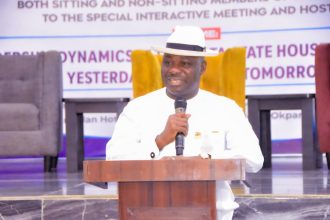
The story of modern Nigerian journalism is incomplete without the contributions of Ray Ekpu, a writer and editor whose career has spanned decades of political change, media transformation, and democratic struggle. Born on August 6, 1948, in Akwa Ibom State, Ekpu rose from a modest background to become one of the most respected voices in Nigerian media. His journey reflects not only personal determination but also the broader evolution of journalism in postcolonial Nigeria.
Ekpu’s early education and training in mass communication laid the foundation for a career defined by intellectual depth and professional discipline. After his National Youth Service, he began work at the Nigerian Chronicle in Calabar in the mid 1970s. His talent quickly became evident as he moved through editorial roles, eventually serving as editor. He later worked with publications such as the Sunday Times and Business Times, where he developed a reputation for thoughtful analysis and a strong commitment to public accountability.
The defining moment in Ekpu’s career came in 1985 with the founding of Newswatch magazine, alongside colleagues such as Dele Giwa, Dan Agbese, and Yakubu Mohammed. Newswatch marked a turning point in Nigerian journalism. It introduced a style that combined investigative reporting with in depth analysis, offering readers a more reflective understanding of national issues. Under Ekpu’s editorial influence, the magazine became a powerful platform for examining governance, exposing corruption, and promoting democratic ideals.
Operating during periods of military rule, Ekpu and his colleagues faced significant risks. The environment for journalists was often hostile, with censorship, intimidation, and detention forming part of the reality of the profession. The assassination of Dele Giwa in 1986 remains one of the darkest moments in Nigerian media history and highlighted the dangers associated with investigative journalism at the time. Despite these challenges, Ekpu maintained a commitment to truth and ethical reporting, reinforcing the role of the press as a watchdog in society.
Ekpu’s writing style has been widely praised for its clarity and balance. Rather than relying on sensationalism, he focused on careful reasoning and factual accuracy. His essays often combined critique with constructive insight, reflecting a belief that journalism should contribute to national development. Beyond his writing, he also played a role in strengthening media institutions, including serving as President of the Newspaper Proprietors Association of Nigeria, where he advocated for press freedom and professional standards.
Over the years, Ekpu has received both national and international recognition. His work earned him global attention, including being named International Editor of the Year by World Press Review in 1987. He has also received several lifetime achievement awards in recognition of his contribution to journalism and public discourse. More importantly, his influence can be seen in the generations of journalists who have drawn inspiration from his work and principles.
Ray Ekpu’s legacy lies in his dedication to truth, accountability, and responsible journalism. His career mirrors the struggles and progress of Nigerian media, especially in its efforts to remain independent and impactful in the face of political pressure. As Nigeria continues to navigate its democratic journey, Ekpu’s work stands as a reminder of the vital role that journalism plays in shaping society and holding power to account.
Credit! North Book,