By Emmanuel Ogoigbe
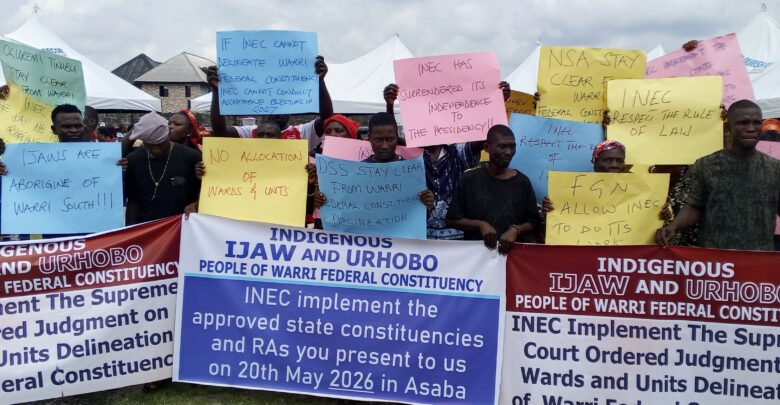
WARRI, DELTA STATE — Tension is escalating in Delta State’s Warri Federal Constituency as Ijaw and Urhobo protesters have accused the Presidency of frustrating the implementation of the Independent National Electoral Commission’s (INEC) final report on the Supreme Court-ordered delineation of electoral wards and constituencies in the area.
Addressing journalists in Warri on Monday, the protesters expressed concern over what they described as an unexplained delay in implementing the delineation report released by INEC on May 20, 2026, warning that the situation could undermine democratic governance, the rule of law and political stability in the constituency.
The group noted that more than ten days after INEC presented the final report to stakeholders in Asaba and indicated that implementation would commence immediately, no visible action had been taken to operationalize the recommendations ahead of preparations for the 2027 general elections.
According to the protesters, the delineation exercise resulted in the creation of 20 registration areas and electoral wards across Warri North, Warri South and Warri South-West Local Government Areas. They also said the exercise produced two additional state constituencies in Warri North and Warri South-West to improve political representation.
The protesters recalled that INEC National Commissioner, Alhaji Abdulrazaq Tukur Yusuf, who represented the Commission’s Chairman during the presentation of the report, had assured stakeholders that political parties would be directed to begin primary elections for the newly created constituencies without delay due to the tight electoral calendar.
However, the group alleged that the implementation process had been halted because of interference from the Presidency.
“We have it on good authority that INEC’s failure to immediately implement the report is as a result of directives from the Presidency to put the implementation on hold,” the protesters claimed.
They described the alleged interference as a threat to constitutional democracy and judicial authority, arguing that INEC is an independent institution not subject to presidential control in the discharge of its constitutional responsibilities.
The protesters further maintained that decisions of the Supreme Court are final and binding on all individuals, institutions and authorities in Nigeria and should therefore be implemented without delay.
The group also dismissed reports that security concerns were responsible for the delay, alleging that such claims were being used as a pretext to influence the outcome of the delineation exercise in favour of the Itsekiri ethnic nationality.
According to them, any genuine security threat should be addressed through appropriate law enforcement measures rather than by suspending the implementation of a court-backed electoral process.
They further argued that the final delineation report had already accommodated significant interests of the Itsekiri people, citing what they described as increases in the number of electoral wards allocated to Itsekiri communities in Warri North and Warri South-West Local Government Areas.
The protesters warned against any attempt to alter or review the final report and insisted that all future electoral activities within the Warri Federal Constituency should be conducted strictly in accordance with the delineation outcome presented by INEC.
They specifically urged the electoral commission to immediately direct political parties to commence primaries for the newly created state constituencies, stressing that affected communities were eager to participate fully in the democratic process ahead of the 2027 elections.
Drawing attention to the history of ethnic disputes in the Warri area, the protesters cautioned authorities against actions capable of reigniting tensions and called for strict adherence to the rule of law through the prompt implementation of the Supreme Court judgment.
The statement was issued on behalf of the Ijaw and Urhobo people of Warri Federal Constituency and released in Warri on June 1, 2026.
As of the time of filing this report, neither INEC nor the Presidency had responded to the allegations.