By Nelson Egware
The mass migration of Nigerian doctors, nurses and other healthcare professionals in search of better working conditions and improved career opportunities abroad has become one of the most pressing challenges confronting the country’s health sector. Popularly known as the Japa syndrome, the trend has continued to deplete the workforce, place additional pressure on available personnel and raise serious concerns about the capacity of public hospitals to meet growing healthcare needs.
Delta State has not been spared the consequences. The departure of experienced medical professionals, coupled with increasing demand for healthcare services, has made it necessary for the government to rethink how public health institutions are managed, staffed and equipped.
However, rather than allow the situation to weaken the state’s healthcare system, the administration of Governor Sheriff Oborevwori has embarked on a series of interventions aimed at strengthening manpower, improving working conditions, upgrading medical facilities and expanding access to specialised healthcare.
The approach is significant because the challenge confronting the health sector goes beyond the number of doctors and nurses leaving the country. It also raises questions about the capacity of hospitals to function effectively, the availability of modern diagnostic equipment and the ability of government to sustain quality healthcare delivery with the personnel and resources at its disposal.
For the Oborevwori administration, the response has been to address these challenges simultaneously, recognising that a functional healthcare system depends on both the people who provide the services and the facilities that support them.
One of the administration’s notable decisions is the approval for the immediate replacement of doctors and other medical personnel who leave the state public service for opportunities abroad.
The Commissioner for Health, Dr Joseph Onojaeme, disclosed this in an interview published by Vanguard on October 29, 2024, explaining that Governor Oborevwori had approved an arrangement to ensure that vacancies created by departing medical personnel were filled without the usual delays associated with public service recruitment.
The policy addresses a major weakness in the health system. In the past, the departure of a doctor or nurse could leave a hospital struggling for months while the process of obtaining approval and recruiting a replacement went through the necessary administrative channels.
By providing for immediate replacement, the government is seeking to prevent such vacancies from disrupting hospital operations or placing an unbearable burden on the professionals who remain in service.
But the administration has also recognised that recruitment alone cannot solve the problem. Medical professionals are unlikely to remain in the public service if their earnings and working conditions do not reflect the demands of their profession.
Consequently, the government approved a monthly tax-free allowance of N200,000 for doctors as part of efforts to improve their take-home pay and make public service more attractive. The state’s commitment to the revised Consolidated Medical Salary Structure (CONMESS) also forms part of the financial incentives designed to improve doctors’ welfare.
Another important intervention is the extension of the retirement age for clinical health workers from 60 to 65 years, subject to stipulated conditions, including medical fitness and the submission of applications six months before the statutory retirement age.
The policy also provides for an extension of the permissible service period for eligible clinical health professionals from 35 to 40 years, or from 60 to 65 years of age, whichever comes first. It covers 26 categories of clinical personnel.
At a time when experienced doctors and other specialists are leaving the country, retaining those who are still willing and able to serve is an important consideration. Beyond their professional competence, senior medical personnel possess institutional knowledge and practical experience that cannot be replaced overnight.
Their continued presence also provides an opportunity for younger professionals to learn from their experience, strengthening the quality of medical practice within the state’s hospitals.
The administration has equally moved to expand the workforce. In March 2026, Onojaeme announced that the government had approved the recruitment of more than 700 medical and non-medical personnel across various health institutions.
The recruitment is intended to strengthen existing facilities and provide the manpower required to support the expansion of healthcare infrastructure across the state.
Under the arrangement, 295 personnel are to be deployed to the Hospital Management Board, 120 to the Delta State University Teaching Hospital (DELSUTH), Oghara, 100 to the College of Health Technology, Ovrode, 60 to Asaba Specialist Hospital and 12 to Central Hospital, Warri, alongside other public health institutions.
The exercise covers different professional categories, including doctors, nurses, pharmacists, laboratory scientists, physiotherapists, health technologists, administrative staff and other support personnel.
The significance of the recruitment lies not simply in the number of people being employed but in the government’s recognition that hospitals cannot deliver effective services without adequate manpower. Modern medical equipment, however sophisticated, cannot substitute for the expertise of trained personnel.
Beyond the manpower challenge, the Oborevwori administration has embarked on an extensive programme of medical equipment acquisition and hospital modernisation.
For many patients, access to specialised diagnostic services has historically involved travelling outside Delta State. Such journeys often come with additional financial costs, physical discomfort and the anxiety associated with seeking treatment far from home.
The government is seeking to change this experience by equipping major public hospitals with modern diagnostic and treatment facilities.
Among the most significant investments are three Siemens Magnetom Flow 1.5 Tesla helium-free Magnetic Resonance Imaging (MRI) machines deployed to major health institutions serving the state’s three senatorial districts.
The machines are designed to support the diagnosis of several medical conditions, including neurological disorders, spinal injuries, joint problems and certain cancers.
The introduction of the equipment represents an important improvement in diagnostic capacity, particularly for patients who previously had to depend on facilities outside the state for some specialised investigations.
The government has also provided three Computerised Tomography (CT) scan machines, including 32-slice and 64-slice equipment, to strengthen diagnostic services at public hospitals.
These investments are particularly important for facilities such as DELSUTH, Oghara, Central Hospital, Warri and Asaba Specialist Hospital, where the availability of modern imaging equipment is expected to improve the speed and accuracy of diagnosis.
Kidney patients have also benefited from the government’s investment in specialised medical equipment.
Eight haemodialysis machines have been distributed among the state’s major hospitals. Central Hospital, Warri, received three, DELSUTH, Oghara, two, while Asaba Specialist Hospital received three.
For patients living with kidney failure, regular dialysis is essential to sustaining life. The availability of additional machines is therefore expected to improve access to treatment and reduce pressure on existing facilities.
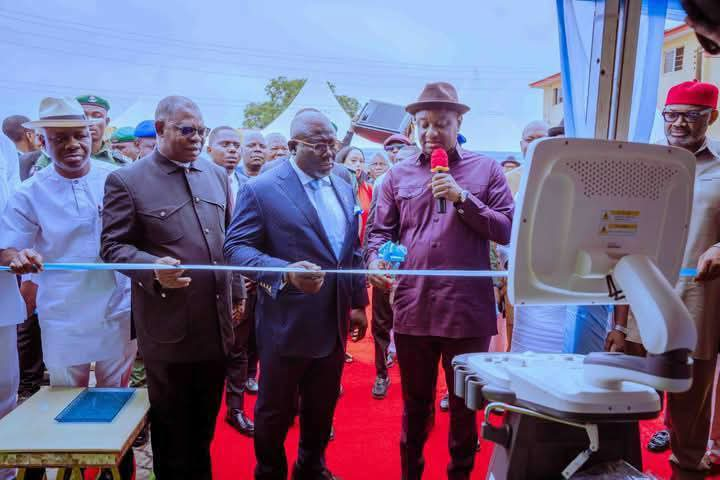
The administration has also distributed 25 modern 4D ultrasound machines across the state’s 25 local government areas, bringing improved diagnostic services closer to pregnant women and other patients requiring specialised ultrasound examinations.
Other interventions include the distribution of nine ventilators to four hospitals, the establishment of intensive care units at Central Hospital, Warri, and Central Hospital, Sapele, and the provision of echocardiography equipment for cardiac investigations at DELSUTH.
The installation of these facilities is expected to strengthen the capacity of public hospitals to manage critical medical conditions and reduce the need for referrals outside the state.
At Asaba Specialist Hospital, the introduction of advanced diagnostic services and the establishment of a dialysis centre have further expanded the range of specialised services available to patients.
The real value of these investments, however, will ultimately depend on their functionality, availability to patients and the ability of hospitals to maintain them. Medical equipment must be properly serviced, supported with trained personnel and supplied with the necessary consumables to deliver the expected benefits.
While considerable attention has been given to specialist hospitals, the administration has also recognised that an effective healthcare system must be built from the grassroots.
Primary healthcare centres are often the first point of contact between residents and the health system. They provide essential services, including immunisation, antenatal care, treatment of common illnesses, health education and referrals for more complicated medical conditions.
It is against this background that the government embarked on the renovation and upgrading of primary healthcare facilities across the state.
The administration’s intervention includes the renovation of more than 150 primary healthcare centres in the first phase, as part of a wider programme covering the state’s 441 facilities. Medical equipment has also been provided to 41 primary healthcare centres to improve their capacity to deliver essential services.
These investments are particularly important to rural communities where residents may have to travel considerable distances to access functional healthcare facilities.
The provision of 25 4D ultrasound machines, one for each local government area, further complements the government’s efforts to improve access to maternal and diagnostic services beyond the major urban centres.
The establishment of the College of Health Technology at Ovrode in Isoko North Local Government Area is another important component of the administration’s healthcare development strategy.
The institution is expected to contribute to the training of middle-level health professionals needed to strengthen primary healthcare delivery and other aspects of the health system.
Similarly, the establishment of the College of Medical Sciences at Southern Delta University, Ozoro, and the strengthening of nursing education at institutions such as the College of Nursing, Onicha-Uku, reflect the government’s recognition that the state’s long-term manpower needs cannot be met through recruitment alone.
Delta must also develop the capacity to train and produce qualified medical professionals who can serve its hospitals and communities.
The administration’s investment in healthcare infrastructure extends to the construction and completion of specialised medical facilities.
One of the major projects is the Mother and Child Hospital at Ekpan, which has been completed and equipped to provide specialised maternal and paediatric healthcare services.
The facility is expected to improve access to medical attention for pregnant women, nursing mothers, newborns and children, particularly those requiring specialised care.
At Osubi Specialist Hospital, Osubi, work is nearing completion on a State Public Health Laboratory, while construction is progressing on a new psychiatric hospital at the same location.
The public health laboratory is expected to strengthen disease surveillance, improve laboratory diagnosis and enhance the state’s capacity to respond to infectious disease outbreaks and other public health emergencies.
The psychiatric hospital, on the other hand, is expected to expand access to specialised mental healthcare, an area that has remained underdeveloped in many parts of the country despite the growing need for mental health services.
Another major investment at Osubi Specialist Hospital is the construction of an In Vitro Fertilisation (IVF) Centre and an Oncology Centre.
The IVF facility is expected to provide couples experiencing fertility challenges with access to specialised reproductive healthcare at a reduced cost. For many families, the financial demands of fertility treatment in private hospitals remain a major obstacle.
The establishment of a public IVF facility therefore presents an opportunity to make assisted reproductive services more accessible to residents who might otherwise be unable to afford them.
The Oncology Centre is equally important. Cancer diagnosis and treatment can be financially demanding, particularly when patients have to travel outside their state of residence to access specialised services.
The proposed centre is expected to improve access to cancer-related diagnostic and treatment services within Delta, reducing the burden on patients and their families.
Taken together, these projects indicate an effort to move the state’s healthcare system beyond routine medical services towards a more comprehensive arrangement capable of addressing specialised and emerging health needs.
Infrastructure and manpower development are only part of the equation. The cost of healthcare remains a major concern for many households, especially those without the financial capacity to pay for treatment when illness occurs.
The Delta State Contributory Health Insurance Scheme is therefore an important component of the administration’s broader health sector intervention.
The scheme is designed to reduce dependence on out-of-pocket payments and improve access to essential medical services, particularly for vulnerable residents.
By spreading healthcare costs through an organised insurance arrangement, the government seeks to ensure that financial limitations do not automatically prevent residents from seeking medical attention.
The importance of this intervention cannot be overstated. A hospital may have qualified doctors and modern equipment, but those facilities will offer limited benefits to residents who cannot afford to access them.
For healthcare reform to have a meaningful impact, improvements in infrastructure must go hand in hand with measures that make treatment affordable.
Governor Oborevwori has consistently emphasised the need to create conditions that will encourage Nigerian medical professionals to remain in the country and contribute to the development of the health sector.
His position was reflected in remarks during a meeting with the leadership of the Nigeria Medical Association, Delta State branch, when he said: “It is better for our doctors to work in Nigeria and earn their respect than to go abroad and become care assistants.”
The statement captures the administration’s concern about the loss of skilled professionals and the need to make the Nigerian healthcare environment more attractive.
It also underscores an important point: the migration of medical professionals cannot be addressed through appeals alone. Doctors, nurses and other healthcare workers need competitive remuneration, functional equipment, opportunities for professional advancement and an environment in which they can practise their professions with dignity.
Delta’s interventions appear to be directed at these concerns through improved remuneration, recruitment, retention policies, training opportunities and investments in hospital infrastructure.
Despite the progress recorded, the challenges confronting the state’s healthcare system remain considerable.
The acquisition of modern medical equipment comes with the responsibility of regular maintenance, technical support and the provision of essential consumables. Hospitals must also have sufficient numbers of trained personnel to operate the equipment and attend to patients.
Similarly, the approval of new recruitment must translate into actual deployment, particularly in rural communities where shortages of doctors, nurses and other healthcare workers can have serious consequences.
There is also the need to sustain improvements in workers’ welfare, strengthen hospital management and provide opportunities for continuous professional development.
These are important considerations because the success of healthcare reform cannot be determined by the number of projects commissioned, machines acquired or policies announced. Its real measure lies in the experience of patients: whether they can obtain timely medical attention, whether treatment is affordable and whether hospitals have the capacity to manage their health needs effectively.
The Oborevwori administration has, however, demonstrated an understanding that the Japa syndrome requires a response that goes beyond persuasion. It requires deliberate investment in people, infrastructure, technology and the conditions under which medical professionals work.
Through its workforce retention measures, immediate replacement policy, fresh recruitment, extended years of service, medical training institutions and extensive hospital upgrades, Delta is pursuing a broad strategy to protect its public healthcare system from the consequences of manpower migration.
The challenge now is to ensure that these interventions are sustained, that new facilities become fully operational and that the benefits reach residents across all parts of the state.
Ultimately, the real test of the administration’s healthcare reforms will be whether a patient in a rural community can access quality medical attention without travelling long distances, whether a kidney patient can receive regular dialysis without unnecessary hardship and whether doctors and nurses can find sufficient professional and economic reasons to build their careers in Delta.
That is the standard by which the state’s response to the Japa syndrome should be judged.
For Delta, the ambition must go beyond keeping its hospitals open. It must be to build a healthcare system that people can trust, professionals are willing to serve and future generations can depend on.
Nelson Egware, PhD, is Executive Assistant to the Governor on Media.