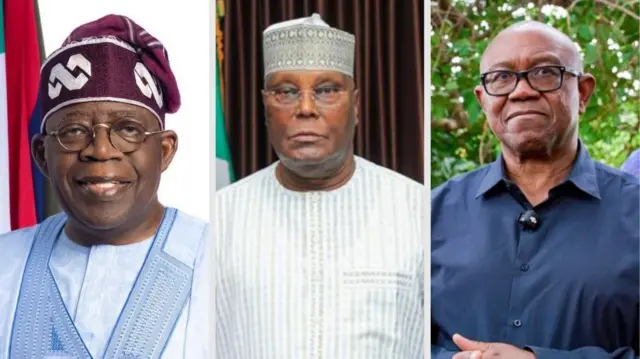
A political commentary has identified four critical conditions that must be fulfilled by opposition parties to stand a realistic chance of defeating an incumbent president in Nigeria’s 2027 general election.
The commentary, titled “How to Win an Incumbent President in Nigeria,” published by RenewedHopeInOyo, examined Nigeria’s presidential electoral history and highlighted the political circumstances that contributed to former President Goodluck Jonathan’s defeat by Muhammadu Buhari in 2015.
According to the commentary, four out of five incumbent Nigerian presidents who sought re-election or a fresh electoral mandate since the return to civilian rule and the Second Republic secured victory, representing an 80 per cent success rate.
It cited the re-election victories of former Presidents Shehu Shagari in 1983, Olusegun Obasanjo in 2003 and Muhammadu Buhari in 2019, as well as Jonathan’s victory in 2011, as examples of the electoral advantage enjoyed by incumbents.
However, it identified the 2015 presidential election, when Jonathan lost to Buhari, as a notable exception that demonstrated the possibility of defeating a sitting president under certain political conditions.
The commentary outlined three major factors, alongside a bonus condition, which it said could determine whether opposition parties have the capacity to unseat an incumbent president.
The first, it said, is the formation of a formidable opposition coalition involving the strongest opposition parties.
It argued that such an alliance must be properly structured, organised and consolidated, with individual party interests subordinated to a common political platform.
It added that a successful coalition should not be a last-minute arrangement but must be established at least one year before an election to build credibility and gain public acceptance.
On the second condition, the commentary identified internal divisions within the ruling party as a major factor that could strengthen the opposition’s chances.
It maintained that opposition parties must not only consolidate their political structures but also benefit from divisions within the ruling party, particularly where influential members defect to the opposition.
According to the commentary, an opposition coalition could struggle to defeat an incumbent if the ruling party remains united and continues to expand its political influence.
The third factor, it said, is the need for an opposition presidential candidate with substantial personal political influence and a strong nationwide following beyond the structures of established political parties.
Using the 2015 election as an example, the commentary argued that the strength of the All Progressives Congress (APC) coalition was complemented by Buhari’s personal political appeal.
It suggested that presenting another candidate, such as Atiku Abubakar, Rabiu Kwankwaso or Rochas Okorocha, might not have produced the same electoral outcome despite the coalition’s political strength and geographical spread.
As a bonus condition, the commentary identified an unfavourable political climate for the ruling party as another factor that could improve the opposition’s chances.
It cautioned against assuming that public dissatisfaction with an incumbent government automatically translates into electoral defeat, recalling that Shagari secured re-election in 1983 despite widespread criticism of his administration.
Applying its analysis to the 2027 presidential election, the commentary questioned whether the current opposition parties have sufficiently fulfilled the conditions required to challenge President Bola Tinubu’s re-election bid.
It also challenged opposition politicians to demonstrate how they intend to build a united political front, exploit possible divisions within the ruling party and present a presidential candidate capable of attracting broad electoral support.
The commentary concluded by asking which of the identified conditions the opposition is realistically positioned to fulfil ahead of the 2027 election.
-RenewedHopeinOyo