
The Chief Executive of the Nigerian Upstream Petroleum Regulatory Commission (NUPRC), Mrs. Oritsemeyiwa Eyesan, has called on Nigeria to prioritise investment in education, human capital development and innovation, stressing that the country’s greatest wealth lies not only in its natural resources but also in the knowledge and capabilities of its people.
Eyesan made the call on Monday while delivering the 56th Founders’ Day Lecture of the University of Benin (UNIBEN), Benin City, Edo State.
The lecture, titled, “The Wealth Beneath Our Feet and the Wealth Within Our Minds: Rethinking Leadership, Education and National Development,” formed part of activities marking the university’s 56th Founders’ Day and 52nd Convocation ceremonies.
The NUPRC chief executive, who is an alumnus of the university, said although Nigeria was endowed with crude oil, natural gas, solid minerals and fertile agricultural land, sustainable national development would depend largely on the ability to develop its human resources.
According to her, natural resources are finite, while human intelligence, when properly nurtured, can continuously generate knowledge, innovation and opportunities.
She said Nigeria’s competitive advantage was not limited to its natural endowments but also included the talent, expertise and ingenuity of its citizens.
Eyesan described universities as critical institutions for national development, noting that they must go beyond awarding certificates to become centres of research, innovation, entrepreneurship and practical problem-solving.
Reflecting on UNIBEN’s history, she recalled that the institution was founded on November 23, 1970, initially as the Midwest Institute of Technology, under the administration of the then Mid-Western State Government led by Colonel Samuel Osaigbovo Ogbemudia.
She acknowledged the contributions of the university’s founding fathers, pioneer administrators, academic staff and students, saying successive generations had sustained the institution’s growth and development.
The NUPRC boss also highlighted the NNPC/Shell Joint Venture Centre of Excellence in Geosciences and Petroleum Engineering at UNIBEN as an example of effective collaboration between universities and industry.
She disclosed that an earlier assessment of the centre’s first seven graduating sets showed that 91 per cent of its 102 graduates were gainfully employed, describing the record as evidence of the importance of connecting academic training with industry requirements.
Addressing students, Eyesan urged them to develop practical skills, embrace technology, pursue innovation and cultivate entrepreneurial abilities rather than depend solely on securing paid employment after graduation.
She encouraged them to identify problems in their communities, develop solutions, collaborate across disciplines, seek mentors and turn their ideas into viable enterprises.
She also stressed the importance of integrity, curiosity and continuous learning, urging students to begin demonstrating leadership and responsibility before occupying positions of authority.
The NUPRC chief executive called for stronger partnerships between the university, the petroleum industry and other stakeholders through scholarships, research grants, industrial attachments, mentorship programmes and technical engagements.
She further urged alumni to remain connected to their alma mater by supporting students and contributing to research, infrastructure and institutional development.
Earlier, the Vice-Chancellor of UNIBEN, Professor Edoba B. Omoregie, SAN, said the Founders’ Day celebration provided an opportunity to reflect on the university’s heritage, achievements and responsibility to contribute meaningfully to society.
Omoregie described the lecture theme as timely, noting that it offered important insights into leadership, education and national development.
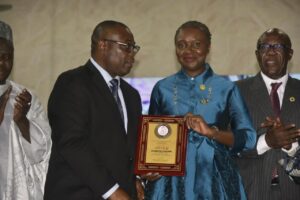
He commended Eyesan for returning to her alma mater to deliver the lecture, describing her professional accomplishments in Nigeria’s petroleum industry as a source of pride to the university and she was therefore given an award.

The Vice-Chancellor reaffirmed the institution’s commitment to connecting academic research with industry needs, promoting entrepreneurship and providing students with practical learning opportunities.
He also acknowledged the support of President Bola Tinubu’s administration and the Federal Ministry of Education for ongoing reforms in the education sector.
The event featured a ceremonial cake-cutting to commemorate the university’s 56th Founders’ Day and 52nd Convocation celebrations.
Students, members of the university management, staff and invited guests participated in the celebration, which formed part of activities leading to the grand finale of the ceremonies.