Former Chairman of the Independent National Electoral Commission (INEC), Professor Attahiru Jega, has identified chronic underfunding, poor governance, outdated curricula, declining academic integrity and inadequate student welfare as major challenges undermining the Nigerian university system.
Jega, who delivered the 2026 Convocation Lecture of the University of Benin (UNIBEN) on Thursday, November 26, called for urgent reforms and increased investment to restore the quality, relevance and global competitiveness of Nigerian universities.
Speaking at the Akin Deko Auditorium, Ugbowo Campus, Benin City, on the theme, “Reinvigoration and Revitalisation of the Nigerian University System: What Is to Be Done?”, the former INEC chairman said the country’s university system had experienced significant expansion without corresponding improvements in funding, infrastructure and quality assurance.
He noted that Nigeria’s university system had grown from just one institution in 1948 to 312 universities as of October 2026, comprising 168 private, 77 federal and 67 state-owned institutions.
However, he lamented that the expansion had not translated into improved access and quality, attributing the challenges confronting the sector to poor governance, misplaced priorities and prolonged neglect.
Jega, a former President of the Academic Staff Union of Universities (ASUU) and former Vice-Chancellor, said inadequate funding remained the root cause of many problems facing universities, including deteriorating infrastructure, poor research facilities, industrial disputes and declining academic standards.
He disclosed that Nigeria allocated approximately 6.15 per cent of its 2026 national budget to education, far below UNESCO’s recommended benchmark of 15 to 20 per cent of public expenditure.
He therefore urged the Federal Government to increase education funding and explore alternative sources of financing, including public-private partnerships, alumni contributions, endowment funds, research grants and income-generating ventures.
On university administration, the don expressed concern over political interference in the appointment of governing council members and vice-chancellors, warning that political patronage and disregard for university autonomy were undermining institutional stability.
He advocated merit-based appointments, transparent decision-making, accountability and respect for the legally established tenure of governing councils.
The convocation lecturer also called for comprehensive curriculum reviews to align university programmes with contemporary technological developments and labour market requirements.
According to him, universities must embrace digital transformation, practical learning, entrepreneurship and interdisciplinary studies to produce graduates capable of addressing societal challenges.
Jega further expressed concern over declining research output, inadequate research funding and the poor global ranking of Nigerian universities, stressing the need for stronger collaboration among universities, government, industries and international institutions.
In a particularly strong observation, he called for a collective effort to address declining academic integrity, citing concerns over plagiarism, examination malpractice, extortion, sexual exploitation and compromised doctoral research.
He stressed that adequate funding alone would not restore the university system without ethical conduct, qualified academic personnel and a renewed commitment to academic excellence.
On student welfare, Jega identified inadequate accommodation, financial difficulties, poor internet access and limited healthcare and counselling facilities as issues requiring urgent attention.
He acknowledged the introduction of the Nigerian Education Loan Fund (NELFUND) as a step towards improving access to higher education but cautioned the Federal Government against creating long-term debt burdens for graduates.
He urged university authorities to prioritise students’ welfare while investing in staff development, research opportunities and improved learning environments.
Earlier, the Vice-Chancellor of the University of Benin, Professor Edoba B. Omoregie, SAN, said university education should go beyond the acquisition of certificates to encompass service, innovation and meaningful contributions to national development.
Omoregie, who welcomed participants to the lecture, urged graduating students to develop resourcefulness, curiosity and problem-solving abilities, noting that academic qualifications alone could no longer guarantee success in an increasingly competitive, technology-driven world.
He said the university remained committed to academic excellence, impactful research and the deployment of research outcomes to address societal challenges.
The Vice-Chancellor also highlighted the institution’s investment in information and communication technology infrastructure, entrepreneurship and the development of staff and students.
He thanked Jega for accepting the university’s invitation and urged parents, guardians, students and other participants to pay close attention to the lecture and apply its lessons in their various endeavours.
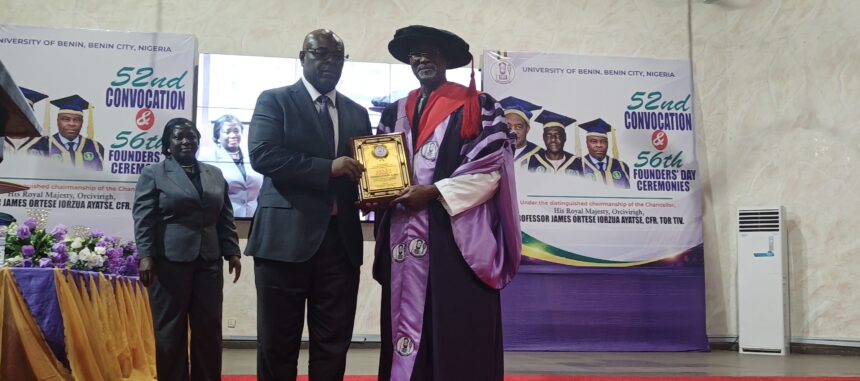
The event formed part of activities marking the university’s 52nd Convocation Ceremony and 56th Founders’ Day celebration.
Present at the Convocation lecture include, Prof. Umaru Shuaibu, Pro-Chancellor and Chairman, Governing Council, Prof. Christopher C. Osunbor, Deputy Vice Chancellor (Administration), Prof. Victor Igbineweka, Deputy Vice Chancellor (Academic), Prof. Buniyamin A. Ayinde, Deputy Vice Chancellor (Ekehuan Campus), Bimpe Omoyiwola, FCPM, University Registrar, Osagie I U. Osifo, Bursar and Prof. Jane I. Aba, University Librarian.
All deans of the university’s 22 faculties were present at the occasion, members of the university community and other invited guests.
The University of Benin Theatre Troupe also entertained guests and participants with performances during the event.
In another highlight, the Airtel Foundation presented laptops and school-fee support to 24 students as part of its educational support initiative.
A representative of the foundation described the intervention as an annual programme and encouraged students to obtain application forms and participate, saying doing so would improve their chances of benefiting from the scheme.
The convocation lecture provided an opportunity for stakeholders in the education sector to reflect on the challenges confronting Nigerian universities and the urgent need for collective action to reposition the nation’s higher education system.