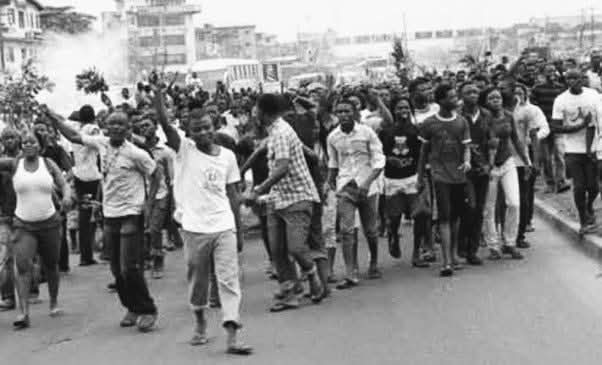
In April 1978, Nigerian students launched a major nationwide protest against government policies under the military regime of General Olusegun Obasanjo (who ruled from 1976–1979). The movement became widely known as “Ali Must Go”, after Colonel (Dr.) Ahmadu Ali, who was then the Federal Commissioner (Minister) of Education and was perceived as the chief architect of the unpopular changes.
Background & Cause
The crisis began when the government, facing economic challenges and rising costs of living, implemented austerity measures that affected university students. While tuition fees remained officially free, the cost of feeding and accommodation was increased:
The cost of meal tickets per day rose from ₦1.50 to ₦2.00 (an increase of 50 kobo).
Hostel accommodation fees were also raised.
Students, organized under the National Union of Nigerian Students (NUNS) led by Segun Okeowo, then president of the union and a student at the University of Lagos initially sought dialogue with the government after regional student meetings in Ilorin, Maiduguri, and Calabar, but rejected the government’s refusal to reverse the fee increases.
The Protests Begin
On 17 April 1978, students began an indefinite boycott of lectures at universities nationwide. When the government did not respond, the boycott evolved into public demonstrations from campus to community.
The students’ demands extended beyond the meal fee issue to include broader calls for democratization, educational access, and improvement in living conditions.
Violence & Government Crackdown
The response from security forces was forceful:
On 18 April 1978, there was a violent confrontation with police at the University of Lagos. A student named Akintunde Ojo was shot and later died of his wounds after reportedly being refused treatment at hospitals.
In Zaria, at Ahmadu Bello University, soldiers engaged demonstrators, and eight more students were reportedly killed during clashes.
The unrest spread across multiple campuses and into cities, involving students and civilians in mass protests against the government’s policies.
Aftermath & Impact
After nearly a week of unrest:
The federal government shut down all universities indefinitely.
NUNS was banned.
Several university leaders and students were expelled or arrested.
Despite the intensity of the protests, the government did not reverse the fee increases.
Segun Okeowo was expelled from the University of Lagos for his leadership role, though he later completed his degree at the University of Ife (now Obafemi Awolowo University).
Significance
The “Ali Must Go” protests are considered one of the most influential student uprisings in Nigerian history. Although the immediate objective, reversing the fee increase was not achieved, the movement:
Legitimized student activism as a political force in Nigeria.
Demonstrated the capacity of organized youth to mobilize nationwide.
Highlighted the power of student unions to challenge even military governments.
Today, “Ali Must Go” remains a major chapter in Nigerian student unionism and popular agitation against economic policy decisions.
Sources
Wikipedia: “Ali Must Go Protests” — overview of causes and effects of the 1978 protests.
Pulse Nigeria: How a 50 kobo increase sparked student protests in 1978.
The Guardian Nigeria: details on student actions and government response.
Historical Nigeria-Yoruba