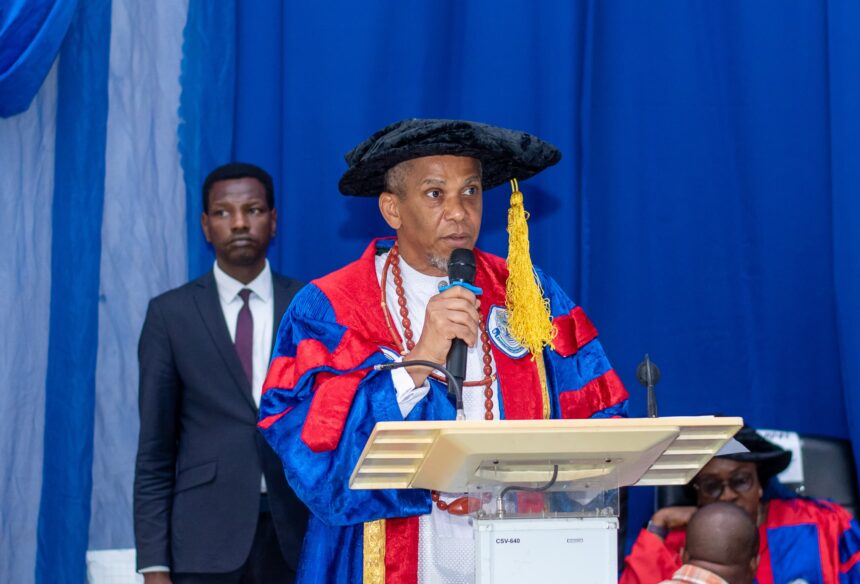
Senator representing Delta Central Senatorial District, Ede Dafinone, has urged Nigerian youths to embrace discipline, innovation and institution-building as essential drivers of sustainable development, warning that the nation risks squandering its vast potential if capacity is not translated into productivity.
He delivered this message while presenting a convocation lecture titled “Harnessing Nigeria’s Potential: Strategies for Sustainable Development” at the 18th Convocation Ceremony of Delta State University (DELSU), Abraka.
Addressing the graduating class of 2026, Dafinone described Nigeria as one of the most naturally endowed countries globally, yet burdened by persistent challenges such as poverty, unemployment, weak institutions and infrastructural deficits.
He raised what he termed “the Nigerian question,” asking why countries with similar levels of potential experience vastly different productivity outcomes. According to him, Nigeria’s core problem is not a shortage of talent but the inability to build effective systems that can harness and sustain productivity.
Despite possessing over 37 billion barrels of crude oil reserves, extensive arable land, solid minerals and a vibrant youth population, he noted that millions of Nigerians still live in extreme poverty, while many skilled professionals continue to migrate abroad in search of better opportunities.
Dafinone described this contradiction as “the Nigerian paradox,” warning that the country’s opportunity for transformation is shrinking as other nations continue to advance economically and technologically.
“The real question is not whether Nigeria will develop,” he said, “but whether this generation will convert its potential into measurable productivity and lasting prosperity.”
He emphasised the need to distinguish between potential and productivity, explaining that potential represents capacity, while productivity reflects the consistent and structured use of that capacity within functional systems.
He further warned against what he called a “dangerous narrative of inadequacy,” stressing that Nigerians must not internalise failure or abandon the long-term work of building strong institutions.
“Sustainable development is not achieved through slogans or ceremonies,” he said. “It requires disciplined, consistent, institution-driven efforts sustained over generations.”
Drawing examples from countries like South Korea, Singapore, Malaysia, Botswana and Rwanda, Dafinone highlighted the importance of investing in human capital and building efficient systems, noting that “systems are more powerful than individuals.”
On the global stage, he identified artificial intelligence and the knowledge economy as significant opportunities for Nigeria to accelerate development. However, he cautioned that technology alone cannot compensate for weak institutions.
Referencing global successes of Nigerians such as Shola Akinlade, Ezra Olubi, Davido, Wizkid, Tems and Burna Boy, he noted that Nigerian talent thrives globally when supported by the right structures and opportunities.
He encouraged graduates to prioritise critical thinking, lifelong learning and intellectual depth, noting a growing shift by employers from credential-based hiring to competence-based evaluation.
While acknowledging the factors driving the increasing “japa” trend, Dafinone urged young Nigerians not to completely abandon the country, stressing the need for capable individuals to contribute to national development from within.
He also criticised Nigeria’s weak execution culture, pointing out that while ideas are abundant, implementation remains a major challenge.
Dafinone concluded by urging the graduates to remain disciplined, focused and committed to continuous self-improvement.
“The potential is already yours,” he said. “What remains is the decision to turn it into consistent, disciplined productivity.”
In his remarks, the Vice-Chancellor of DELSU, Prof. Samuel Ogheneovo Asagba, described the lecture as insightful and reflective of Nigeria’s realities, urging graduates to apply its lessons as they step into the next phase of their lives.