By Staff Reporter
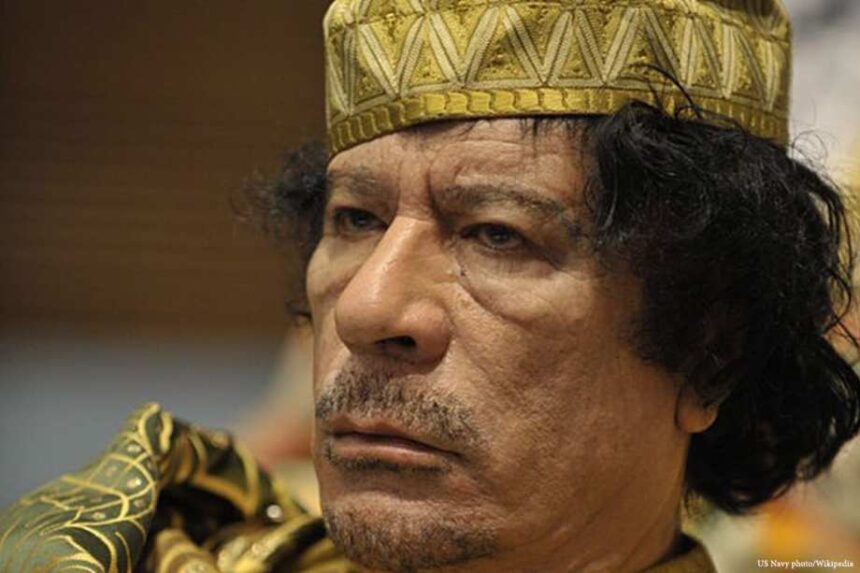
Muammar Gaddafi’s four-decade rule in Libya left a complicated and enduring mark on Africa, combining an ambitious vision of continental unity with controversial military interventions, political alliances and accusations of authoritarianism.
Gaddafi seized power in Libya in a bloodless military coup in September 1969, overthrowing King Idris. Backed by the country’s growing oil revenues, he transformed Libya into an influential regional power and used its financial resources to project influence well beyond North Africa.
Champion of a United Africa
One of Gaddafi’s most prominent political ambitions was the creation of a more politically and economically integrated Africa.
He repeatedly advocated for a United States of Africa, arguing that the continent needed stronger political institutions, a common defence structure and greater economic independence from outside powers. His proposals included a single African passport, a unified government and continental military cooperation.
Gaddafi also promoted the idea of a single African currency, sometimes referred to as the African dinar, which he envisioned as being backed by gold. The proposal was presented as a way of reducing Africa’s dependence on the US dollar and Western financial institutions.
Although the project never materialised, Gaddafi became one of the most outspoken advocates of a more politically independent and economically integrated Africa.
Libya’s Oil Wealth and African Investments
Gaddafi used Libya’s substantial oil revenues to finance investments and political initiatives across the continent.
Libya provided financial assistance, development funding and infrastructure support to a number of African countries, while Libyan state institutions and companies invested in sectors ranging from telecommunications and banking to agriculture and infrastructure.
These initiatives earned Gaddafi support among some African leaders and political movements, particularly those who viewed his policies as a challenge to Western influence on the continent.
His relationship with the African Union also became increasingly prominent. Gaddafi pushed for greater African integration and was an important financial supporter of continental institutions and projects.
Rebel Movements and Regional Interventions
Gaddafi’s African legacy, however, extends far beyond his calls for unity.
For decades, Libya under Gaddafi supported political movements, rebel groups and governments in different parts of Africa. His involvement was particularly significant in countries such as Chad, where Libya became deeply entangled in regional conflicts.
His government also maintained relationships with controversial African political figures and movements, including Charles Taylor in Liberia and Idi Amin in Uganda. These relationships generated considerable criticism and contributed to perceptions of Gaddafi as a leader willing to use Libya’s wealth and military capabilities to pursue geopolitical influence.
His interventions were therefore viewed differently across Africa: some saw them as support for anti-colonial and anti-Western movements, while others regarded them as interference in the affairs of sovereign states.
A Divisive Figure in African Politics
Gaddafi’s grand vision for Africa never achieved the level of political integration he sought.
Major African states, including Nigeria and South Africa, did not always share his approach to continental integration. His ambitions were sometimes regarded as unrealistic, while his efforts to exert influence over other African governments created political tensions.
At the same time, supporters and some African intellectuals continued to regard him as an outspoken critic of colonialism, Western intervention and Africa’s economic dependence on foreign powers.
That image exists alongside serious criticism of his domestic rule, including allegations of political repression and human-rights abuses. His government’s treatment of sub-Saharan African migrants also became a source of controversy, particularly amid wider concerns about racism, exploitation and abuses against migrants in Libya.
The End of an Era
Gaddafi’s rule came to an abrupt end in 2011, when an uprising against his government developed into a civil war and international military intervention.
He was captured and killed near Sirte in October 2011, ending 42 years of rule.
More than a decade later, his African legacy remains contested. To some, Gaddafi represents an ambitious attempt to build a more united, independent and economically self-reliant Africa. To others, his legacy is inseparable from authoritarian rule, regional interventionism and the destabilising consequences of his foreign policy.
Ultimately, Gaddafi’s place in African history reflects the tension between his vision of continental independence and the controversial methods he used to pursue influence. His dream of a politically and economically integrated Africa remains unfinished, even as debates over African sovereignty, regional integration and economic independence continue.
Credit: African historical,