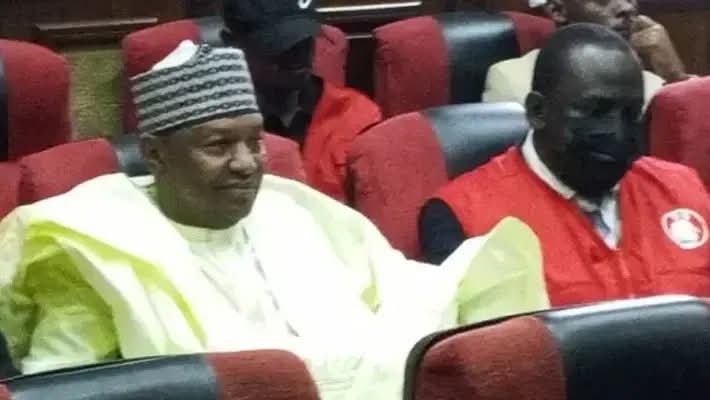
Proceedings in the ongoing criminal case involving a former Attorney-General of the Federation and Minister of Justice, Abubakar Malami, SAN, took a notable turn on Wednesday when the trial judge, Justice Emeka Nwite of the Federal High Court, disclosed that he had received approaches aimed at influencing his decision in the matter.
Justice Nwite made the disclosure shortly after granting bail in the sum of ₦1.5 billion to Malami and his co-defendants. He cautioned that no individual or group should attempt to interfere with the judicial process or seek to compromise the court.
Malami, who served as Nigeria’s Attorney-General and Justice Minister from November 2015 to May 29, 2023, during the administration of former President Muhammadu Buhari, is standing trial alongside his son, Abdulaziz Malami, and his wife, Hajia Bashir Asabe.
The defendants are facing a 16-count charge bordering on alleged money laundering, preferred by the Economic and Financial Crimes Commission (EFCC). The anti-graft agency alleges that the total sum involved in the case is approximately ₦9 billion.
According to the EFCC, the former justice minister and his co-defendants allegedly acquired properties in Abuja, Kebbi and Kano states as part of efforts to conceal the proceeds of unlawful activity. The agency further told the court that between July 2022 and June 2025, a company identified as Metropolitan Auto Tech Limited was allegedly used to retain over ₦1.01 billion in a Sterling Bank account.
The prosecution also alleged that between September 2020 and February 2021, the same company was involved in transactions amounting to about ₦600 million. In addition, the EFCC claimed that another firm, Rayhaan Hotels Limited, allegedly retained ₦600 million in March 2021 as cash collateral for a ₦500 million loan from Sterling Bank, with the funds said to be of questionable origin.
The EFCC maintained that the alleged actions contravened provisions of the Money Laundering (Prohibition) Act, 2011.
All the defendants pleaded not guilty to the charges. The court subsequently granted them bail, while adjourning the matter for continuation of trial.