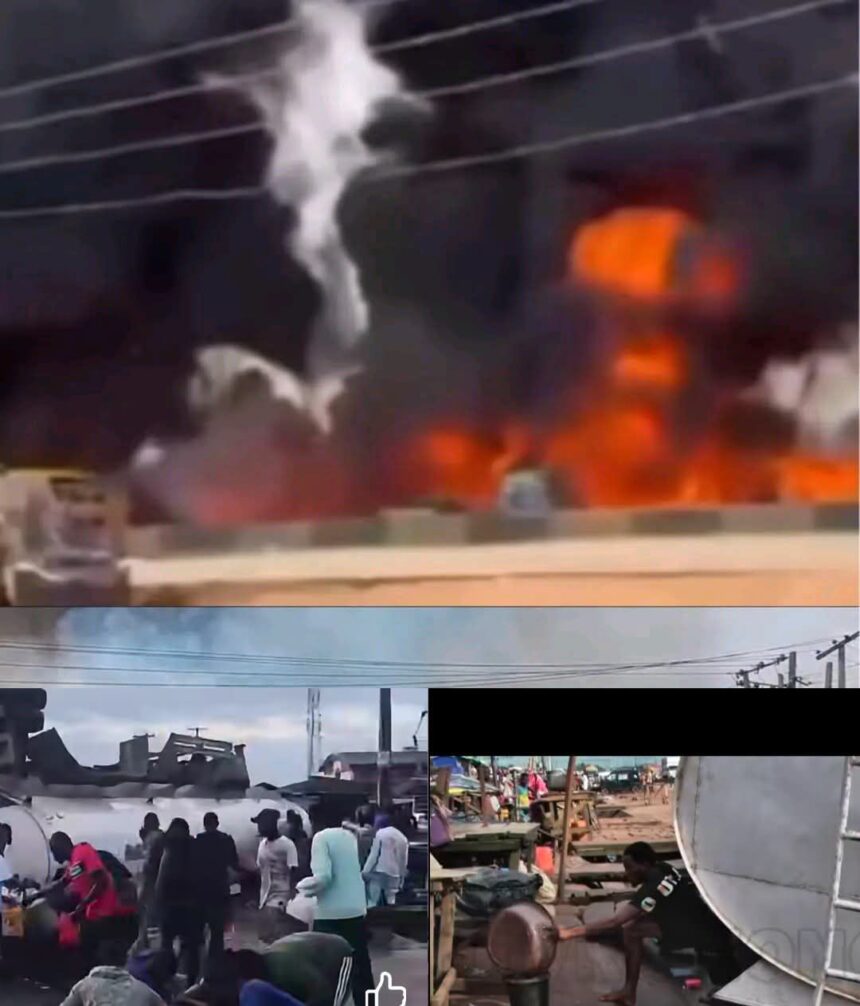
BENIN CITY, Edo State — Reactions have continued to trail the tragic petrol tanker explosion near Oluku Market along the Benin-Lagos Expressway in Edo State, with Nigerians expressing grief over the incident and renewing calls for members of the public to stay away from fallen fuel tankers.
The explosion, which occurred on Thursday, October 15, 2026, reportedly left several people dead or severely burnt, while nearby shops and other structures were engulfed in flames. Several injured victims were also reportedly rushed to the University of Benin Teaching Hospital (UBTH) for emergency medical treatment.
Following the incident, social media users have expressed sadness over the disturbing images and videos circulating online, with many warning against the dangerous practice of scooping petrol from fallen tankers.
One commentator, reacting to the incident, described the footage of burnt victims as disturbing and urged Nigerians to desist from gathering around overturned tankers to collect fuel.
The commentator attributed the practice partly to greed, arguing that people should prioritise their lives over the potential financial benefits of collecting spilled petrol.
Another social media user recalled the October 17, 1998, Jesse fire disaster in Delta State, in which more than 1,000 people reportedly died after a pipeline explosion during an attempt to scoop fuel.
The user noted that previous tragedies and repeated warnings had failed to prevent similar incidents, urging Nigerians to learn from past experiences and avoid fallen tankers and leaking pipelines.
Other commentators questioned the actions of motorists who continue driving close to accident scenes involving fuel tankers, stressing the need for caution whenever such incidents occur.
One user argued that motorists should seek safer routes or keep a considerable distance from overturned tankers rather than continue their journeys through potentially dangerous areas.
Another contributor, however, shifted attention to the response of relevant authorities, questioning whether timely intervention could have prevented the incident from escalating into a deadly inferno.
The reactions also highlighted the economic hardship facing many Nigerians, with some arguing that hunger and poverty may push people to take dangerous risks in an attempt to survive.
One commentator expressed concern that, despite the latest tragedy, people might still gather around another overturned tanker in the future because of the prevailing economic difficulties.
Another user said the victims travelling in vehicles that became trapped in the flames deserved particular sympathy, as they might have been caught up in the disaster without participating in the reported fuel-scooping activity.
The incident has once again drawn attention to the dangers associated with spilled petroleum products, which can ignite and cause devastating fires when exposed to an ignition source.
Safety advocates have repeatedly urged members of the public to avoid approaching overturned fuel tankers or attempting to collect spilled petrol. Instead, people should move away from the scene and allow emergency responders and relevant authorities to handle the situation.
As reactions continue to pour in, the Oluku tragedy has renewed calls for greater public awareness, improved emergency response and stronger measures to prevent avoidable deaths arising from tanker accidents.
While public opinion remains divided over the roles of poverty, personal responsibility and institutional response, many Nigerians agree that the loss of lives in such incidents must serve as a warning about the dangers of approaching fallen fuel tankers.