By Staff Reporter
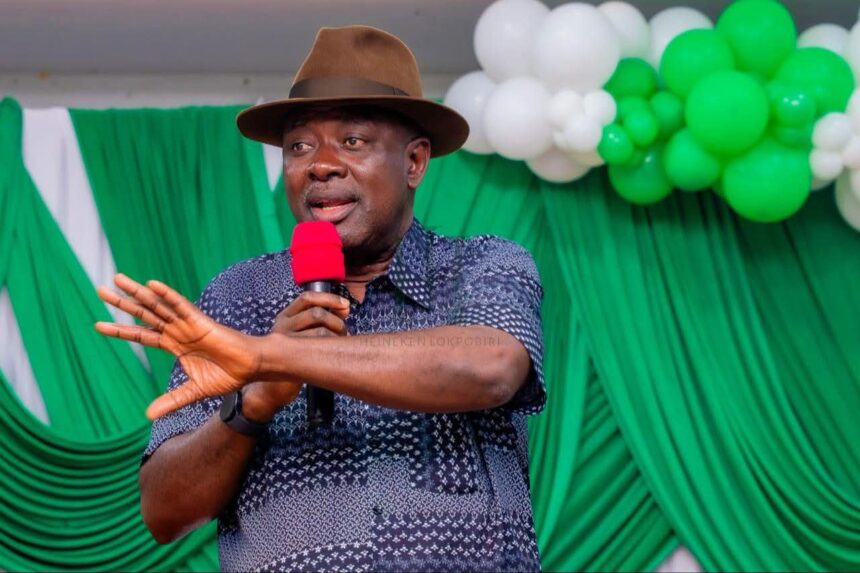
Minister of State for Petroleum Resources (Oil), Heineken Lokpobiri, has urged Nigerians to shift part of their attention from the Federal Government to state and local governments in demanding accountability over the increased revenues they receive following the removal of fuel subsidy.
Lokpobiri made the call while responding to criticisms of the Federal Government’s fuel subsidy policy and concerns raised by opposition figures, including former Vice President Atiku Abubakar and former Anambra State governor Peter Obi.
According to the minister, Nigeria was projected to spend about ₦18.4 billion daily on fuel subsidy payments when President Bola Tinubu assumed office in May 2023.
He said the figure, based on projections earlier presented to the National Assembly by former Minister of Finance, Budget and National Planning, Zainab Ahmed, would have amounted to roughly $15 billion annually, or about ₦21 trillion at an exchange rate of ₦1,400 to the dollar.
“Where would the money come from?” Lokpobiri asked, arguing that the funds would ultimately have to come from the same oil sector that generates a significant portion of Nigeria’s revenue.
The minister also argued that the subsidy regime contributed to the financial difficulties previously experienced by the Nigerian National Petroleum Corporation (NNPC), before its transformation into NNPC Limited.
He said the former NNPC struggled to meet financial obligations associated with its participation in oil production, including its share of joint venture costs, commonly referred to as cash calls.
“You recall that NNPC never paid any dividend. NNPC never made any profit at all,” Lokpobiri said, adding that the corporation largely operated by exporting crude oil and importing refined petroleum products.
He explained that the arrangement became financially unsustainable because NNPC was required to contribute its share of the costs of joint venture operations.
“If you say you own 60 per cent of a business, you also have to pay 60 per cent of the cost of doing that. That is the cash call,” he said.
According to Lokpobiri, the situation has since changed, claiming that NNPC Limited no longer owes cash calls.
The minister also linked the subsidy debate to Nigeria’s broader fiscal challenges, particularly debt servicing.
He claimed that debt service previously consumed about 97 per cent of government revenue, leaving the government in a position where it was effectively borrowing to meet existing obligations.
Lokpobiri said the ratio had subsequently declined to about 60 per cent.
A major part of his argument centred on the distribution of revenues previously committed to fuel subsidy payments.
He said funds freed from the subsidy regime are now reflected in increased allocations shared among the federal, state and local governments through the Federation Account Allocation Committee (FAAC).
“Today, all of you can attest to the fact that for the first time, at the end of every month, FAAC is convened and over ₦2 trillion is shared every month,” he said.
Official figures have shown that FAAC allocations have crossed the ₦2 trillion mark on some occasions. In March 2026, for instance, the three tiers of government shared ₦2.036 trillion, according to figures from the Federal Ministry of Finance.
Lokpobiri therefore argued that the increase in allocations should come with greater scrutiny of how state and local governments spend the funds they receive.
He maintained that Nigerians should not focus exclusively on the Federal Government when demanding accountability over resources made available after subsidy removal.
“The proceeds from subsidy removal are shared among the three tiers of government: federal, state and local government,” he said.
“But instead of people holding their state governments accountable, their local governments accountable, everybody is looking at the federal government.”
The minister further claimed that the increased revenue available to states had improved their ability to meet their financial obligations.
“Before this government came in, 27 states could not pay salaries. Today, even the poorest states have enough money, not just to pay salaries, but also to do projects,” he said.
Lokpobiri also rejected allegations that funds made available through the removal of fuel subsidy were not being properly utilised by the Federal Government.
“That statement is absolutely false,” he said.
He pointed to initiatives including the Nigerian Education Loan Fund (NELFUND), compressed natural gas (CNG) initiatives and clean-cooking programmes as examples of government interventions that he said demonstrate how resources have been deployed following the end of the old subsidy regime.
The minister’s comments come amid continuing debate over the economic and social consequences of fuel subsidy removal, with government officials defending the policy on fiscal grounds while critics continue to question its impact on living costs and household welfare.