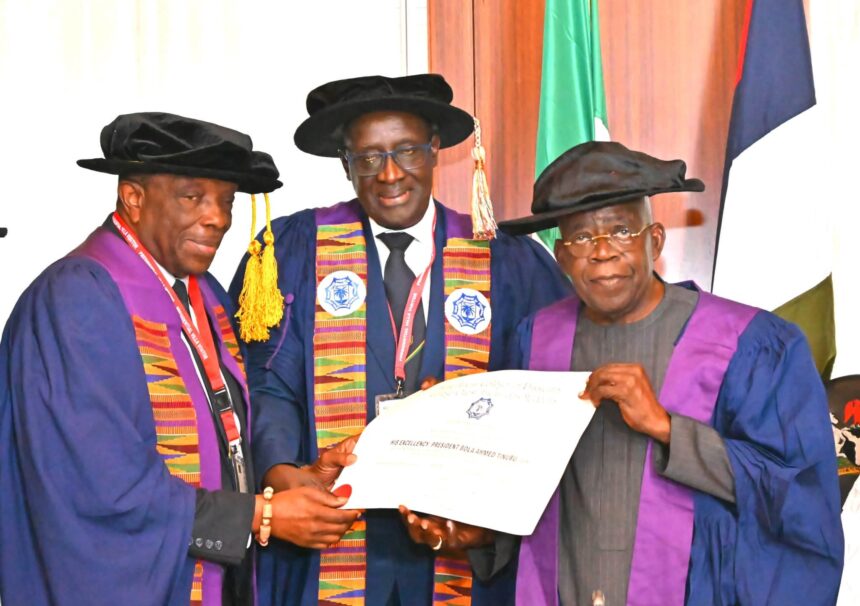
President Bola Tinubu has urged medical professionals across West Africa to develop practical and sustainable solutions to the growing migration of skilled healthcare workers, warning that the trend is putting increasing pressure on healthcare systems in the sub-region.
Tinubu made the call on Thursday in Abuja after being conferred with a Fellowship of the West African College of Physicians (WACP) in recognition of his administration’s contributions to healthcare reforms and medical development in Nigeria.
According to a statement issued by his Special Adviser on Information and Strategy, Bayo Onanuga, the President urged the college’s leadership to use its forthcoming conference to develop workable strategies to address the persistent challenge of medical brain drain.
He noted that the migration of trained medical professionals to other parts of the world had reduced the availability of essential healthcare services and increased the workload of personnel remaining in the system.
“We are more challenged in Africa than anywhere else,” Tinubu said, while expressing concern over emerging health threats and the need for preventive measures against infectious diseases.
The President pledged his administration’s continued support for the medical profession and reaffirmed its commitment to comprehensive health sector reforms aimed at making healthcare more accessible, affordable and efficient for Nigerians.
He also commended the Coordinating Minister of Health and Social Welfare, Professor Muhammad Ali Pate, for his role in driving the reforms.
“We as a government are doing everything possible. Please help me congratulate the reform-oriented physician, Ali Pate, who has been doing a very good job,” the President said.
Tinubu further acknowledged the contributions of medical professionals to humanity through research, disease prevention, life-saving interventions and the development of resilient healthcare systems capable of responding to emerging and existing health challenges.
The WACP conferred the fellowship on the President through its council, with the college’s President and Chairman of the Board of Trustees, Dr Mamadou Mourtala Ka, saying the honour was reserved for presidents whose policies and actions had made a significant impact on healthcare delivery across West Africa.
“This award is given only to presidents who have made a mark in healthcare delivery and affected the health of the West African people,” Ka said.
The college’s Secretary-General, Professor Musa Dankyau, who spoke on behalf of the delegation, said the decision reflected the Tinubu administration’s commitment to far-reaching reforms in the health sector.
Dankyau disclosed that the college had conferred the fellowship only eight times in its 50-year history. He identified former Gambian President Dawda Jawara as the first recipient and former Nigerian Head of State, General Ibrahim Babangida, as the previous Nigerian recipient in 1991.
He said the council recognised Tinubu’s administration for its investments in health infrastructure, improved access to healthcare and emergency services, as well as initiatives to strengthen primary healthcare and advance universal health coverage.
“At the last count, over $2.2 billion had been invested in that area for the health of the Nigerian people,” Dankyau said.
He also cited progress in disease prevention, immunisation and public health preparedness, adding that the Federal Government had expressed readiness to respond to potential Ebola threats.
The meeting was attended by the Secretary to the Government of the Federation, Senator George Akume; the President’s Chief of Staff, Femi Gbajabiamila; the Minister of Information and National Orientation, Mohammed Idris; and the Special Adviser to the President on Health Matters, Dr Salma Ibrahim Anas, among other officials.
The college also informed the President of its forthcoming 50th anniversary celebration and Annual General Scientific Meeting, scheduled for October 26 to 28, 2026, at the Bola Ahmed Tinubu International Conference Centre in Abuja.
The event is expected to bring together medical professionals and other stakeholders to discuss developments and challenges in healthcare across the West African sub-region.