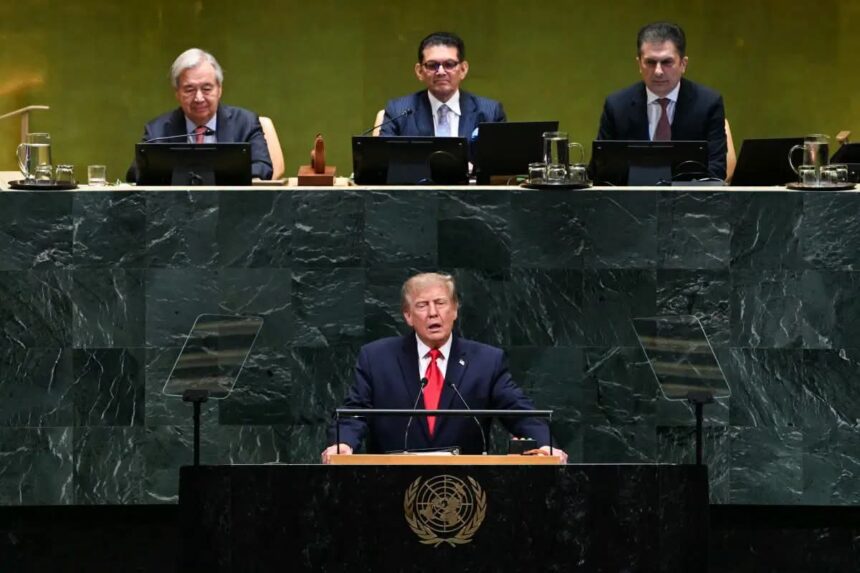
NEW YORK — US President Donald Trump has warned that Iran could face devastating consequences if it fails to reach an agreement with Washington to end the ongoing Middle East conflict, telling world leaders at the United Nations General Assembly that he faces a choice between a deal and what he described as the “annihilation” of the Islamic Republic.
Speaking on Tuesday, September 22, 2026, during his address to the 81st UN General Assembly in New York, Trump said he was considering whether to pursue an agreement that would allow Iran to rebuild or take further military action against the country.
“I have a big decision to make,” Trump told the gathering, according to Reuters. He then asked whether he should “annihilate the Islamic Republic” or pursue a deal that would allow Iran to become “one of the greatest in the Middle East or even the world.”
Trump also said he believed a diplomatic agreement with Tehran remained possible, suggesting that negotiations could produce a deal after the US midterm elections in November.
“I believe we’ll make a deal right after the election because it doesn’t make sense for them not to,” he said.
The US president claimed Iran was waiting to see how Republicans perform in the midterm elections, while stressing that he himself was not on the ballot.
“They’re waiting to see how I do in the midterm election. What they don’t realize is that I’m not running. I did that already, and won in a landslide,” Trump said.
Trump also reiterated that he would not allow Iran to acquire a nuclear weapon, presenting the US military campaign as necessary to prevent that outcome. Iran has consistently rejected US accusations that it is seeking to develop nuclear weapons.
The remarks came as diplomatic efforts surrounding the conflict continued. US Secretary of State Marco Rubio said Washington remained open to talks with Iranian representatives, although no meeting between the two sides had been scheduled at the time.
Iranian delegates were also reported to have walked out of the General Assembly chamber during Trump’s address, while Iranian President Masoud Pezeshkian and Foreign Minister Abbas Araghchi were not present in the hall when Trump began speaking.
The confrontation has also raised wider concerns over global energy supplies. Iran has reportedly offered to reopen the Strait of Hormuz within seven days if the United States eases military pressure and lifts its blockade of Iranian ports, a development that has contributed to renewed attention on diplomatic efforts to end the conflict.
Trump’s remarks have placed renewed focus on the possibility of negotiations between Washington and Tehran even as military tensions remain high.