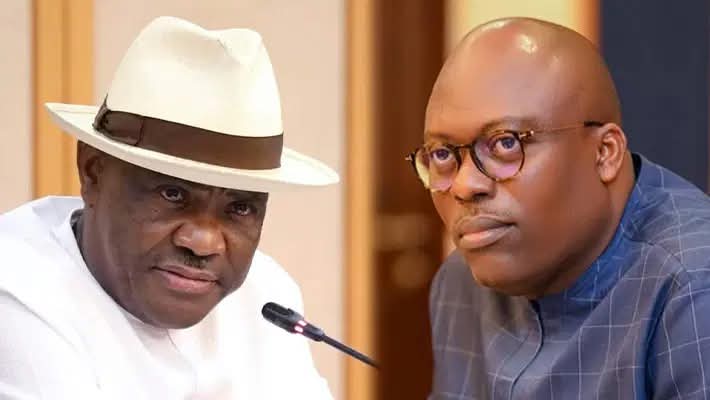
The Minister of the Federal Capital Territory (FCT), Nyesom Wike, has dismissed reports suggesting that Rivers State Governor, Siminalayi Fubara, has emerged as the leader of the All Progressives Congress (APC) in the state following his recent defection to the ruling party.
Speaking on Monday, Wike described the claims as misleading and politically inaccurate, stressing that the APC in Rivers State has an established structure and leadership that cannot be altered by a single defection, regardless of the individual’s status as governor.
According to the former Rivers State governor, joining a political party does not automatically confer leadership, noting that the APC has long-standing members who have worked to build and sustain the party in the state. He emphasized that party leadership is determined by internal processes, loyalty, and contributions over time, not by political office alone.
Wike’s comments come against the backdrop of months of political tension between him and his successor, Governor Fubara. The duo had been locked in a fierce power struggle that polarized the Rivers State political landscape, affected governance, and led to deep divisions within the state’s political class. Although both camps have recently signaled a truce, with reports of reconciliation and renewed dialogue, underlying rivalries appear far from resolved.
While acknowledging that peace efforts were ongoing and in the interest of stability in Rivers State, Wike maintained that such reconciliation should not be misinterpreted as a transfer of political control or influence within the APC.
Political observers note that Fubara’s defection has intensified speculation about a possible realignment of power ahead of future elections, but Wike’s remarks suggest that any attempt to redefine the party’s leadership structure may face resistance from existing stakeholders.
As the situation unfolds, the APC in Rivers State is expected to clarify its leadership hierarchy, even as analysts warn that lingering tensions between key political actors could continue to shape the state’s political dynamics