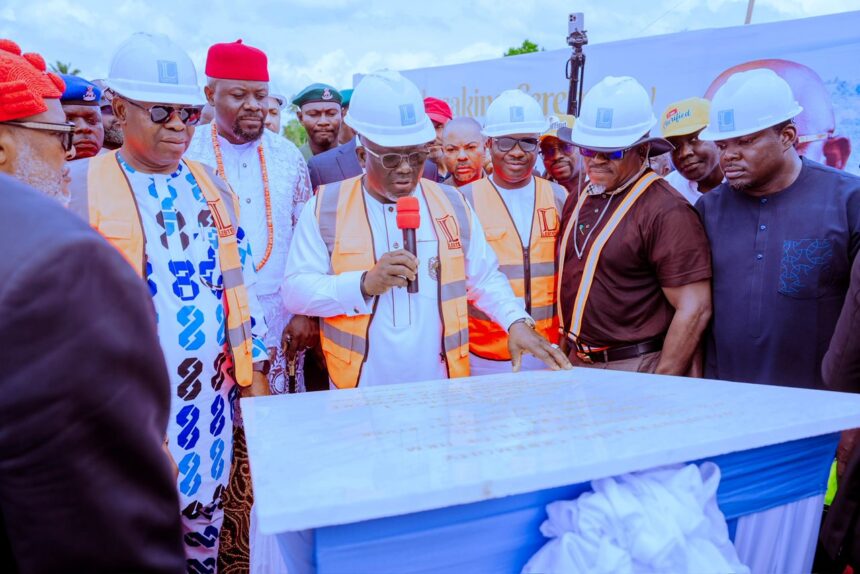
Delta State Governor, Sheriff Oborevwori, on Wednesday officially flagged off the construction of the N29.8 billion Aboh-Akarai Road and Bridge project in Ndokwa East Local Government Area, reaffirming his administration’s commitment to expanding infrastructure development across rural, riverine, and urban communities in the state.
Speaking during the groundbreaking ceremony, the governor said his administration remained deliberate and focused in delivering projects that would improve connectivity, stimulate economic activities, and enhance the living standards of residents across Delta State.
Oborevwori explained that the project became a priority after the Deputy Governor, Monday Onyeme, attended a burial ceremony in Akarai and experienced firsthand the difficulty of accessing the community due to poor road conditions.
According to the governor, the deputy governor passionately appealed for the approval of the road project upon his return, stressing that it would positively impact several rural communities.
“This project is a fulfillment of that promise. It demonstrates our determination to ensure that no community is left behind, regardless of location or terrain,” Oborevwori stated.
The governor disclosed that the 11-kilometre road, which stretches from Aboh through Umuti to Akarai-Obodo and Akarai-Etiti, would be constructed using reinforced concrete pavement because of the swampy and flood-prone nature of the area.
He noted that the terrain consists of thick mangrove forests, deep swamps, low-lying sections, and heavy clay soil, making asphalt unsuitable for the environment.
Oborevwori further revealed that the project includes concrete drainage systems, culverts, and a 140-metre multi-span bridge across the Okiri River. He added that the road was intentionally designed above the flood levels recorded during the 2012 flooding disaster to guarantee all-season accessibility.
Describing the project as a major economic lifeline for the affected communities, the governor said it would ease transportation, improve access to markets, create jobs, and attract investments to the area.
“For years, many residents depended almost entirely on river transportation. With this road, movement will become easier, farmers can move produce faster, students will access schools more conveniently, and patients can reach healthcare facilities without stress,” he said.
The governor also announced that the contractor handling the project had already been mobilized to site with a 40 percent advance payment of N11.9 billion, expressing confidence that the work would be completed within the 12-month timeline.
He disclosed that the next major project to be flagged off by his administration would be the N32.8 billion Ojobo-Torugbene Road project in Burutu Local Government Area.
Oborevwori urged community leaders, youths, and residents to cooperate with the contractor to ensure the smooth execution of the project.
In his remarks, Deputy Governor Monday Onyeme thanked the governor for what he described as unprecedented commitment to the development of Ndokwa Nation.
He said communities that had long lacked meaningful road infrastructure were now being connected under the current administration, noting that Akarai community would witness a tarred road for the first time in its history.
Onyeme also highlighted other ongoing and approved projects across Ndokwa Nation, including the Emu-Ebendo–Ashaka Road, Ase–Umu-Ase Road, Eweshi–Otokutu Road, Ndemili–Utagba-Uno Road, and the Amai–Aragba Road project.
Commissioner for Works (Highways and Urban Roads), Reuben Izeze, commended the governor for embarking on ambitious infrastructure projects across the state despite economic challenges.
Chairman of Ndokwa East Local Government Area, Vincent Oshilonya, described the project as a long-awaited intervention that would improve transportation, commerce, and livelihoods in the area.
Traditional rulers and community leaders, including the Obi of Aboh Kingdom, Greg Oputa III, also praised the governor for prioritizing infrastructure and development projects across Ndokwa communities.