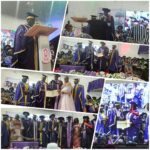
Chief Walter Boyo, Managing Director and Chief Executive Officer of Aroma Foodland Global Company Limited, has urged Nigerians, irrespective of age, to embrace continuous learning, describing education as a vital tool for effective leadership, business growth and national development.
Boyo gave the advice shortly after receiving a Master’s degree in Global Business Management from the Department of Business Administration, Faculty of Social and Management Sciences, University of Benin (UNIBEN), during the institution’s 52nd Convocation and 56th Founders’ Day ceremonies.
Speaking with journalists at the ceremony, the Sapele-based businessman said his decision to return to the classroom was driven by the need to broaden his knowledge of leadership and management, which he identified as major challenges affecting Nigeria’s development.
He said the example of former President Olusegun Obasanjo, who pursued further education later in life, inspired and challenged him to return to academic studies.
According to him, the constantly changing global business environment makes continuous learning necessary for individuals seeking to remain relevant and achieve sustainable growth.
“Education has no boundary, and I want to challenge both young and old to continue seeking knowledge. Acquiring this Master’s degree is not an end but a means to greater opportunities,” he said.
Boyo disclosed that he had already purchased an application form to pursue a PhD, stressing that he was determined to advance his academic qualifications.
“I’m not stopping at this level. I have already purchased my PhD form, and I wish to further my education,” he added.
Reflecting on the challenges encountered during the programme, the businessman said commuting from Sapele, Delta State, to Benin City for lectures, particularly during the first semester, was demanding.
He also identified an eight-month strike as one of the major setbacks that affected the programme and prolonged its duration.
Despite the challenges, Boyo commended the university’s lecturers and management for their support, particularly the flexible payment arrangement that allowed students to pay their tuition fees in instalments.
He described the arrangement as helpful and affordable, noting that it made it easier for him to combine his academic pursuit with his business responsibilities.
“It was time-consuming, but everything worth doing is worth doing well,” he said.
On the benefits of the qualification, Boyo said he intended to apply the knowledge acquired to improve his business operations and contribute more meaningfully to society.
He emphasised the importance of clear goals, sound policies and a positive organisational culture in driving business advancement and sustainable growth.
The Aroma Foodland Global Company Limited boss also expressed appreciation to his family for their sacrifices, commitment and understanding throughout the programme.
He equally commended his staff for taking charge of the company’s operations and ensuring that business activities continued smoothly whenever he was away attending lectures.
Boyo’s graduation was part of UNIBEN’s 52nd Convocation, during which the university graduated 11,357 students, comprising 8,789 first-degree graduands and 2,568 postgraduate graduands.
The Vice-Chancellor, Professor Edoba B. Omoregie, SAN, disclosed that the undergraduate category included 140 First Class graduates, 2,589 Second Class Upper, 4,465 Second Class Lower and 513 Third Class graduates.
The postgraduate category comprised 484 PhD holders, 44 MPhil graduates, 1,409 Master’s degree recipients and 631 Postgraduate Diploma holders.