….Says neglect of local stories has obscured contributions of Nigerian film pioneers
Professor Ambrose Uchenunu of the University of Benin (UNIBEN) has called on Nigerian filmmakers and scholars to prioritise indigenous storytelling, warning that failure to document the country’s history and cultural heritage through film could lead to the distortion and eventual loss of important historical accounts.
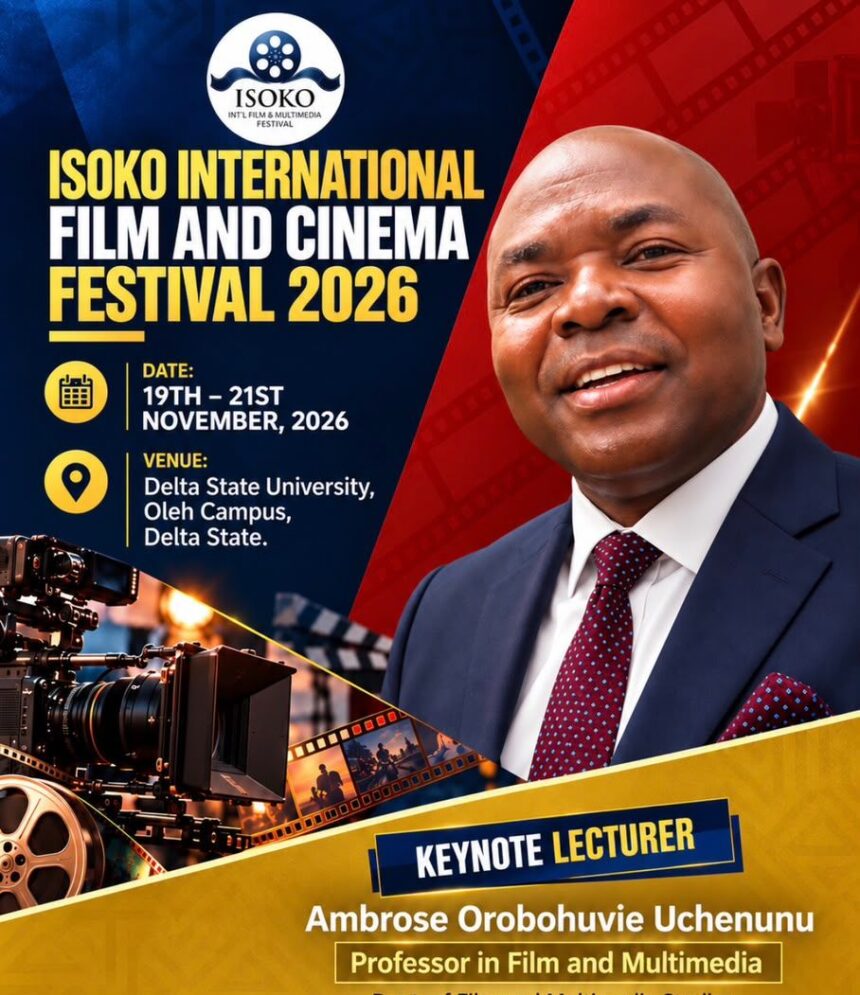
Uchenunu, a Professor of Film and Multimedia Studies and Head of the Department of Film and Multimedia Studies at UNIBEN, made the call while delivering the keynote address at the maiden Isoko International Film and Cinema Festival 2026, held at the Delta State University, Oleh Campus, Delta State.
Speaking on the theme, “Identity, History and Culture,” the university don emphasised the power of cinema as a tool for preserving cultural identity, documenting history and connecting younger generations with their ancestral heritage.
He explained that films go beyond entertainment, serving as historical archives through which audiences can understand the language, traditions, marriage customs, religious practices, music, food and social values of communities.
According to him, cinema provides an opportunity for people to encounter aspects of their history that may have been excluded from conventional historical accounts.
“The screen now becomes an archive, the actor becomes a conduit of memories, the filmmaker becomes an interpreter of history, and the audience becomes a witness,” he said.
Uchenunu argued that every film carries a particular interpretation of society because filmmakers make deliberate choices about what audiences see and how stories are presented.
Citing the works of cultural theorist Stuart Hall, he noted that meaning in films is constructed through representation, language and culture, adding that cinema often reflects society while also shaping how people perceive themselves and others.
He expressed concern that Africa, particularly Nigeria, had for decades been represented through the perspectives of foreign storytellers, resulting in narratives that often failed to capture the diversity and realities of its people.
The professor stressed that indigenous filmmakers must take responsibility for changing this trend by producing films that authentically represent Nigerian communities, histories and experiences.
Tracing the development of Nigerian cinema, he discussed the contributions of pioneers such as Hubert Ogunde and the emergence of Nollywood, noting that indigenous-language productions played a significant role in attracting audiences and promoting cultural identity.
He also highlighted the importance of indigenous languages in filmmaking, observing that the use of languages such as Isoko, Yoruba, Igbo, Hausa, Edo, Ijaw, Tiv and Nigerian Pidgin gives films cultural authenticity and helps preserve the knowledge and memories embedded in those languages.
Referencing Kenyan writer Ngũgĩ wa Thiong’o, Uchenunu maintained that language is more than a means of communication, as it carries the memories, values and worldview of a people.
He warned that when indigenous languages are excluded from public storytelling, future generations risk losing access to the expressions, humour, traditions and historical experiences associated with them.
A major highlight of the keynote address was his revelation about the 1957 Nigerian film Freedom, which he said had been overlooked in accounts of the country’s cinematic history.
According to him, the film, shot in colour celluloid in Nigeria, was nominated for the 7th Berlin International Film Festival in 1957 and featured John Ifoghale Amata, an Isoko-born filmmaker widely regarded as one of the pioneers of Nigerian cinema.
Uchenunu said Amata co-wrote the film’s script and played the role of Mutanda, a revolutionary leader in a story centred on land grabbing.
He expressed concern that despite Amata’s significant contribution to the production, his name appeared last among the listed cast members, while his role in the film had received little attention in mainstream accounts of Nigerian cinema.
He questioned why the 1957 film had been largely overlooked in the historical documentation of Nigerian filmmaking, particularly when Kongi’s Harvest, produced in 1970, is frequently cited as a major starting point in the country’s cinematic history.
The professor called for further research into the film and the contributions of early Nigerian filmmakers, arguing that the omission underscores the consequences of failing to tell and preserve indigenous stories.
He urged emerging filmmakers, researchers and cultural institutions to investigate neglected aspects of Nigerian cinematic history and ensure that the contributions of indigenous pioneers receive proper recognition.
Concluding his address, Uchenunu reiterated the need for Nigerians to take ownership of their narratives, stressing that telling indigenous stories is essential to preserving identity, strengthening cultural consciousness and ensuring that future generations understand their history.
He ended with a reminder that historical claims must be subjected to independent scrutiny, urging his audience to investigate and verify the accounts presented.
The Isoko International Film and Cinema Festival 2026, held from November 19 to 21, brought together filmmakers, scholars and cultural stakeholders to examine the relationship between cinema, identity, history and cultural preservation.