By DADA AYOKHAI
The Etsako region of Edo North has long been recognised as a fertile ground for producing seasoned politicians and technocrats who have played pivotal roles in shaping public policy and driving governance in Edo State. Over the years, individuals from this axis have contributed significantly to the state’s development through service across successive administrations.
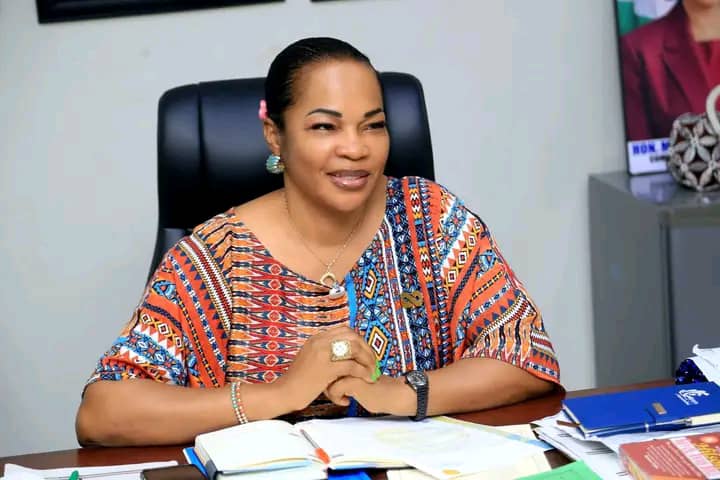
From time to time, however, new names emerge—figures who not only challenge established political hierarchies but also introduce fresh energy and ideas into public service. One such rising figure is Mrs Eugenia Abdallah, the Edo State Commissioner for Women Affairs and Social Development.
Hailing from the Etsako axis, Mrs Abdallah has rapidly carved out a distinct identity for herself in the administration of Governor Monday Okpebholo, where her performance continues to draw growing attention. Until a few years ago, she was largely unknown in the public political space. Today, she stands as one of the administration’s most visible and impactful commissioners, with her ministry increasingly regarded as a barometer for inclusive governance.
Mrs Abdallah is a graduate of English from Edo State University, Iyamho (Uzairue), and holds a Postgraduate Diploma in Public Administration from the Enugu State University of Science and Technology. Her swift rise in government underscores not only her dedication but also the clarity of purpose she has brought to her role.
One striking feature of Mrs Abdallah’s public service journey is her simple, focused, and hands-on approach to leadership. Since her appointment, she has operated an open-door policy that encourages accessibility, dialogue, and stakeholder engagement—an approach that has resonated strongly within and outside her ministry.
Beyond her natural charisma, she has emerged as a strong advocate for greater female participation in democratic governance, consistently emphasising the transformative impact women can have when afforded opportunities to lead and contribute meaningfully. Those who have worked closely with her often remark on her rare blend of humility, enthusiasm, and people-centred leadership—qualities that have earned her admiration, particularly given her relatively young age.
Governor Okpebholo’s decision to appoint Mrs Abdallah as Commissioner is widely regarded as a strategic and forward-thinking move—one that signals a deliberate commitment to rebuilding Edo State through competence, innovation, and inclusivity.
Observers familiar with the inner workings of her ministry note that Mrs Abdallah assumed office with a clear strategic blueprint aligned with the governor’s vision. She has distinguished herself as one of the few commissioners willing to embrace innovative and technology-driven solutions to address complex social challenges. This inclination is hardly surprising, given her professional exposure across sectors including banking, oil and gas, and other industries.
Perhaps the most telling demonstration of her leadership capacity is her handling of the sensitive issue of street begging in Edo State—a matter fraught with social, religious, and ethnic complexities. In the past, similar challenges have led to the downfall of public officials who mishandled them.
Rather than relying on outdated methods such as forceful eviction, Mrs Abdallah adopted a collaborative and consultative approach, engaging key stakeholders to build consensus. She successfully balanced the need to address a growing social concern with the imperative to respect and protect the fundamental human rights of vulnerable individuals.
Her outreach included consultations with influential community figures, such as Arewa leaders and the Chief Imam of the Benin Central Mosque, where she highlighted the often-overlooked realities of street begging—exploitation, neglect, abuse, and systemic poverty.
Simultaneously, she articulated the government’s broader vision: not merely removing beggars from public spaces, but unlocking their potential through skills acquisition, education, and social reintegration.
In a related development, during a recent visit by the management of the National Obstetric Fistula Centre (NOFIC), Mrs Abdallah seized the opportunity to advocate for stronger collaboration between her ministry and relevant agencies. Her focus was on expanding access to free and quality healthcare services for women, particularly in the areas of prevention, rehabilitation, and reintegration.
She drew attention to the alarming number of women in Edo State who silently suffer from preventable conditions such as obstetric fistula and uterine prolapse, often constrained by stigma, poverty, and limited access to healthcare.
Expressing optimism, Mrs Abdallah affirmed her belief that a sustained partnership between her ministry and NOFIC would significantly reduce these burdens, restore dignity, and provide life-changing support to affected women across the state.