The Power Behind the Throne: The Iyoba Institution in the Benin Political Structure.
In the Kingdom of Benin, power was never confined to the throne alone. It was distributed, reinforced, and sustained through institutions that ensured continuity across generations. Among the most remarkable of these is the Iy’Oba institution, the formal recognition of the Queen Mother as a political, spiritual, and cultural authority in her own right.
The creation of this institution is credited to Oba Esigie (c. 1504–1547), who established the title of Iy’Oba to honour his mother, Queen Idia. But this act was far more than a gesture of gratitude. It was a structural innovation, one that permanently embedded maternal power within the governance of the kingdom.
Queen Idia herself was no ordinary royal figure. She was a strategist, a political force, and a warrior who played a decisive role in securing her son’s reign, including her involvement in the Benin–Idah war of 1516. Oral tradition preserves her legacy with reverence:
“Okhuo ma ghi ye okuo de so kun Idia ne iye Esigie”
“No woman has ever gone to war before except Idia, mother of Oba Esigie.”
Through her actions, Idia redefined what was possible for women within the royal structure. Through the institution of the Iy’Oba, her influence became permanent.
Within Benin’s political hierarchy, the Iy’Oba holds a clearly defined and elevated position. She ranks as the fifth senior chief among the Eghaevbo n’Ore, following the Iyase, Esogban, Eson, and Osuma. Notably, she is the only woman within this upper echelon, underscoring both the uniqueness and significance of the role.
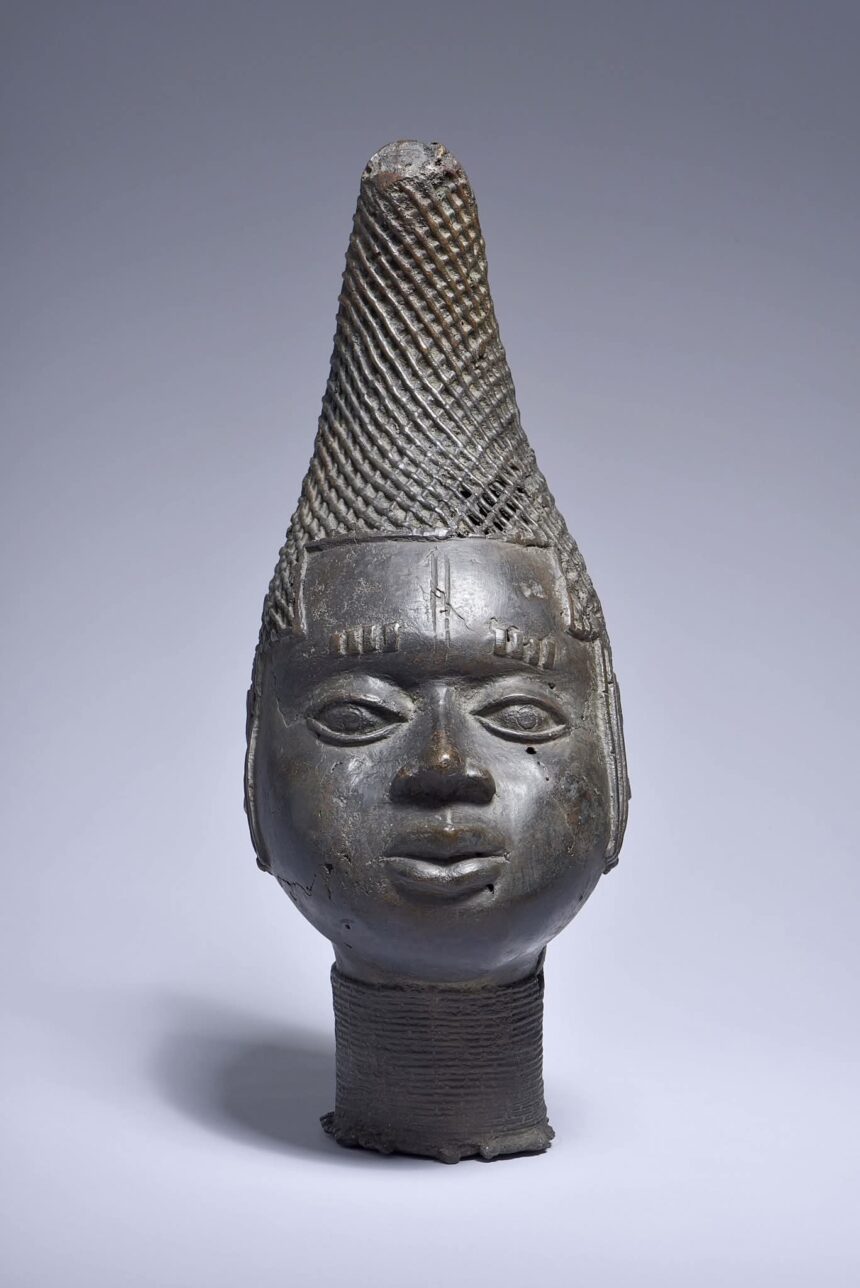
This authority is expressed not only in governance but also in art and ritual. Like the Oba, the Iy’Oba is honoured with ancestral altars, located in her domain at Uselu. At the centre of these altars are the commemorative heads (Uhunmwu-Elao ọghe Iy’oba)—distinctive works that encode her identity and status.
These heads are immediately recognizable. They feature a high, forward-projecting coral bead crown and an elongated coiffure known as ukpẹ okhokho or ukpe okhue, the “chicken beak” or “parrot beak” hairstyle. This projecting form, called ede Iyoba, is not merely decorative. It is a visual declaration of authority. Coral, reserved for royalty, reinforces her proximity to the Oba, while her facial markings (Ikharo) anchor her within Benin identity and lineage.
Through these artistic forms, the Iy’Oba is not only remembered, she is made present. Her altar becomes a site where memory, ritual, and authority converge.
Over time, the Iy’Oba institution evolved into a continuous lineage, with each Oba recognizing and honouring his mother within this framework. The record of Iy’Obas across Benin history reflects both continuity and the enduring importance of maternal authority within the kingdom.
Below is a list of Obas and theirs mothers (Iyʼoba)
Esigie – 1504–1547: Idia
Orhogbua – 1547–1580: Elaba
Ehengbuda – 1580–1602: Umelu
Ohuan – 1602–1656: Not conferred
Ohenzae – 1656–1661: Unknown
Akenzae – 1661–1669: Eson
Akengboi – 1669–1675: Enahen
Akenkpaye – 1675–1684: Edin
Akengbedo – 1684–1689: Ohogha
Ore-Oghene – 1689–1701: Imarhiaede
Ewuakpe – 1701–1712: Ewebonoza
Ozuere – 1712–1713: Unknown
Akenzua – 1713–1740: Ihasogie
Eresoyen – 1740–1750: Ede
Akengbuda – 1750–1804: Ohogha
Obanosa – 1804–1816: Ose
Ogbebo – 1816: Unknown
Osemwende – 1816–1848: Omozogie
Adolo – 1848–1888: Ugiomo
Ovonranmwen – 1888-1914: Iheya
Eweka II – 1914–1933: Eghaghe
Akenzua II – 1933–1978: Ariowa
Erediauwa – 1979–2016: Aghahowa
Ewuare II – 2016– : Ikuoyemwen
Image Credit: Museum Rietberg
Benin Traditional,Benin History,