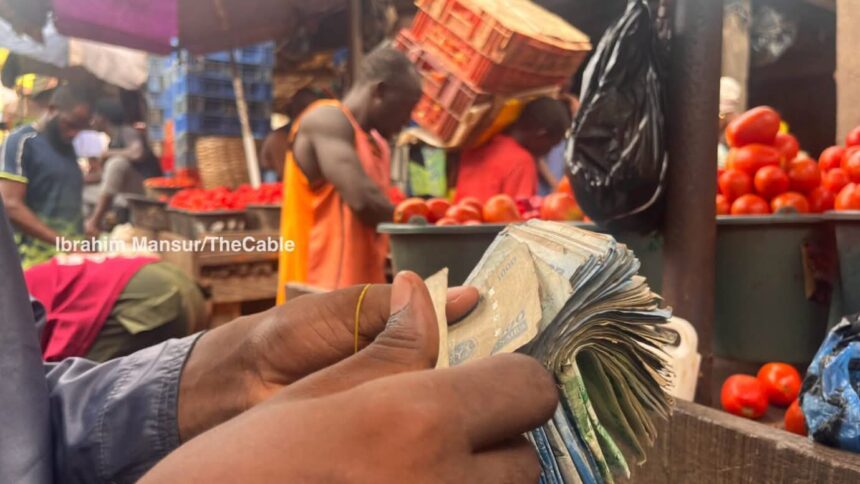
For many Nigerian households, going to the market is no longer just about deciding what to cook for the week. It has become an exercise in survival — comparing prices, cutting quantities and deciding which essentials can be postponed as the cost of feeding a family continues to climb.
For households already grappling with higher transportation, housing, healthcare and other living costs, food inflation is putting further pressure on disposable income and making it increasingly difficult to save.
“I used to buy yam, tomatoes, pepper, chicken and other things without thinking too much about the price. But they have become more expensive. Now, before I pick anything, I check the price and calculate what I can afford,” Damilola, a Lagos-based woman who lives alone, said.
According to her, the money that previously covered her weekly groceries now runs out within a few days.
She has consequently reduced the quantities she buys and increasingly focuses on food items that can be stretched across several meals.
Her experience mirrors the situation in many Nigerian homes, where consumers are adjusting their spending habits as food prices continue to rise.
Food inflation climbs
The latest figures from the National Bureau of Statistics (NBS) show that Nigeria’s food inflation rate rose to 20.31 per cent in July 2026, up from 17.52 per cent in June.
The bureau attributed the increase to changes in the average prices of several food items, including fresh pepper, tomatoes, onions, eggs, rice, garri and plantain.
Although the country’s headline inflation rate moderated slightly to 15.43 per cent in July, the increase in food inflation highlights the continuing pressure on one of the most important components of household spending.
For many consumers, the figures are being felt less in economic statistics and more at market stalls and supermarket counters.
Prices squeeze household budgets
A survey of food prices in markets across Lagos, Ogun State and Abuja shows the extent of the pressure confronting consumers.
In Lagos, a paint bucket of fresh pepper now sells for about N9,000, compared with roughly N7,000 previously. Tomatoes cost about N12,000, compared with around N6,000 a year ago, while onions that previously sold for between N6,000 and N7,000 now cost about N12,000.
Plantain sells for between N2,000 and N3,000, depending on size, while a crate of eggs costs about N6,000. A bag of rice sells for around N70,000, chicken for approximately N6,000, and a bag of garri for about N38,000.
The situation is similar in Ogun State, where a small basket of tomatoes sells for about N10,000, up from N6,000 previously. Peppers cost around N7,000, compared with about N5,000 a year ago.
A crate of eggs sells for approximately N6,000, while a bag of rice costs about N65,000, compared with N55,000 previously.
In Abuja, a small bucket of fresh pepper sells for around N20,000, while a basket of tomatoes costs between N15,000 and N20,000.
A bag of rice sells for between N58,000 and N60,000, while a bag of garri costs about N26,000.
A large bunch of plantain goes for around N7,000, while a crate of eggs sells for between N6,000 and N6,500.
‘We buy only what we can afford’
The rising prices are changing not only what Nigerians buy but also how they shop.
Some households are buying smaller quantities more frequently to avoid exhausting their cash, while others are replacing preferred food items with cheaper alternatives.
For others, discretionary spending has almost disappeared.
Eating out, buying snacks, purchasing premium food items and indulging in personal cravings are increasingly being viewed as luxuries that can be sacrificed to keep basic household needs covered.
For low- and middle-income earners, the situation is particularly challenging because food already takes up a substantial share of household income.
As prices rise faster than incomes for many consumers, families are forced to make difficult trade-offs between food, savings, transportation, education, healthcare and other necessities.
Savings, nutrition take a hit
The pressure is also extending beyond the immediate cost of food.
With more income being diverted towards feeding, households have less money available for savings and emergencies. Some families are reportedly postponing investments and relying more heavily on existing savings to meet routine expenses.
There are also concerns about nutrition as consumers increasingly prioritise foods that provide the most calories for the least money.
The consequence is a gradual shift from buying what households want to eat to buying what they can afford.
For families like Damilola’s, the weekly shopping list is no longer determined by appetite alone.
It is determined by the size of the wallet.
And as food inflation continues to squeeze household budgets, the question for many Nigerians is no longer “What are we craving?”
It is increasingly “What can we afford?”
Credit: TheCable