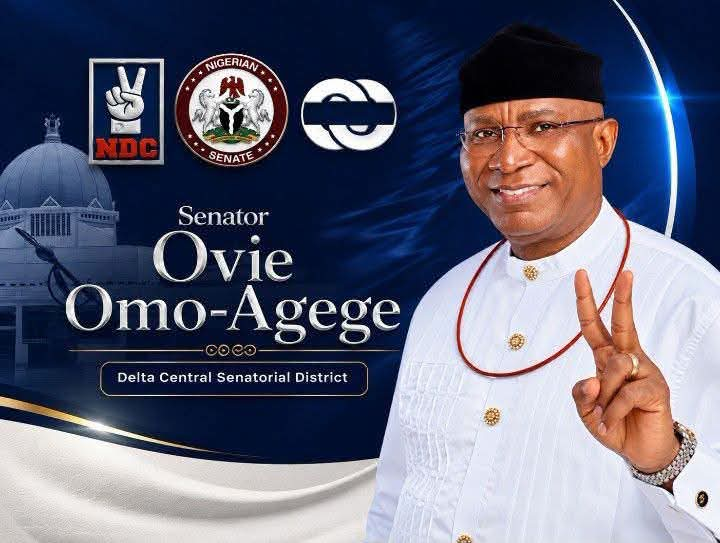
Former deputy Senate president’s aide says statement targets electoral fraud, not voters, insists 2027 polls must be decided by ballots
The camp of former Deputy President of the Senate, Senator Ovie Omo-Agege, has defended his controversial “rig and die” remark ahead of the 2027 general elections, insisting that the expression was directed at electoral fraudsters and not voters or legitimate election officials.
In a press statement dated October 27, 2026, and signed by Godwin Anaughe, Special Adviser on Strategy and Communications to Omo-Agege, the former senator’s camp accused the Delta State Government, some All Progressives Congress (APC) supporters and their media allies of deliberately misrepresenting the remark as a call to violence.
Anaughe maintained that the statement was intended as a warning against electoral malpractice, including vote manipulation, ballot theft, vote-buying and the falsification of election results.
According to him, the phrase represents a rejection of electoral fraud and a call for voters to defend their mandates through lawful means.
“‘RIG AND DIE’ is not a threat to voters. Voters don’t rig elections. It is a threat to riggers who falsify election figures and results,” the statement said.
The aide argued that the declaration was consistent with the constitutional principle that political power must be obtained through lawful democratic processes.
Omo-Agege’s Camp Accuses Political Opponents of Hypocrisy
The statement accused Delta State Commissioner for Works (Rural Roads) and Public Information, Charles Aniagwu, and Senator Ede Dafinone’s camp of applying double standards in their reactions to Omo-Agege’s remarks.
Anaughe cited previous statements by former APC National Leader Bola Tinubu, who reportedly used the expression “rig and roast” in 2014, and former President Muhammadu Buhari’s warning against ballot-box snatching during the 2019 general elections.
He questioned why similar rhetoric had attracted different reactions, arguing that Omo-Agege’s statement should be understood within the context of efforts to prevent electoral malpractice.
The statement also revisited the controversy surrounding the removal of the Senate mace in April 2018, defending Omo-Agege’s actions during the incident.
Anaughe maintained that the former deputy Senate president had gone to the Senate to resume his legislative duties following a court judgment challenging his suspension. He denied that Omo-Agege stole the mace and described his actions as a defence of legislative independence and constitutional order.
2023 Governorship Election Dispute Resurfaces
Omo-Agege’s camp also revisited the 2023 Delta State governorship election, alleging that the former senator was denied victory through electoral manipulation.
The statement accused former Governor Ifeanyi Okowa and incumbent Governor Sheriff Oborevwori of working with political allies to undermine Omo-Agege’s electoral prospects, particularly in parts of Delta North Senatorial District.
These allegations were presented by the former senator’s camp and were not independently established in the statement.
Anaughe further accused the incumbent governor and some APC figures of preparing to manipulate the 2027 elections, claims that were not accompanied by independently verifiable evidence in the release.
The statement said Omo-Agege and his supporters would resist any attempt to manipulate the forthcoming elections, stressing that the results must reflect the votes cast by the electorate.
Calls for Credible Elections in 2027
The former senator’s camp called on the Independent National Electoral Commission (INEC) and security agencies to remain impartial, protect voters and ensure accurate counting and collation of results.
It also urged voters across Delta State to remain vigilant at polling units and collation centres, insisting that the 2027 elections must be determined by ballots rather than manipulated results.
According to Anaughe, any resistance to electoral malpractice would be lawful, peaceful and resolute.
“Omo-Agege has no apology. He spoke the mind of Nigerians,” the statement added, arguing that the former senator’s commitment to electoral reforms informed his position on the controversy.
The statement concluded with a call for the protection of voters’ mandates and the conduct of credible elections in Delta State in 2027.
The controversy surrounding the “rig and die” expression has brought renewed attention to the language political actors use when discussing electoral integrity, particularly the distinction between forceful opposition to election fraud and rhetoric that could be interpreted as encouraging violence.
As political activities ahead of the 2027 elections gather momentum, the response to such statements is likely to remain part of the wider debate over peaceful campaigning, electoral accountability and democratic stability.