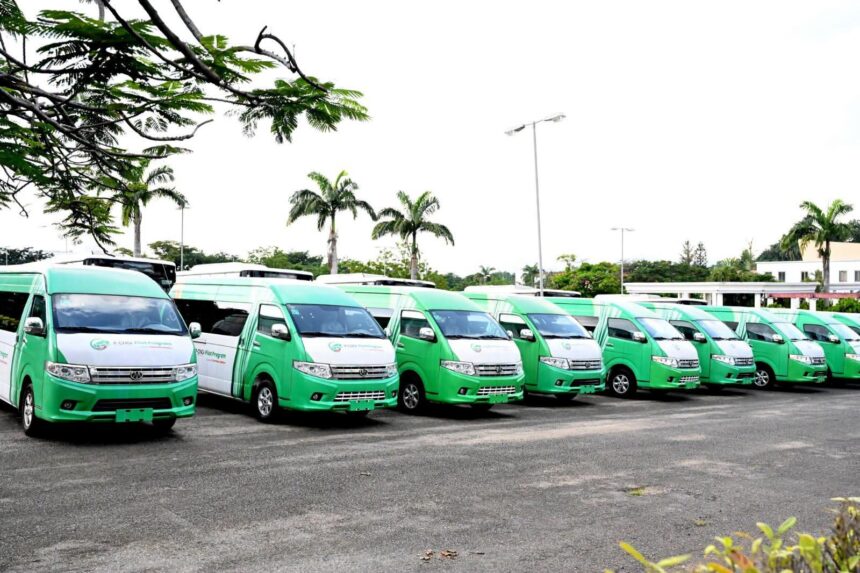
President Bola Ahmed Tinubu has said the Federal Government is intensifying efforts to expand compressed natural gas (CNG) and electric-powered transportation across Nigeria, with the aim of reducing transport fares for millions of Nigerians.
Tinubu disclosed this in a statement on Saturday, September 19, 2026, while giving an update on the National Affordable CNG Transit Programme.
According to the President, he met with the governors of the 36 states on August 27, where they agreed on an objective to ensure that more Nigerians begin to experience measurable reductions in transportation costs from October 1.
He said an implementation committee had subsequently been established under the auspices of the Nigeria Governors’ Forum, with Kwara State Governor, AbdulRahman AbdulRazaq, as chairman.
Tinubu said the committee, PI-CNG & EV, state governments and other stakeholders were already working to identify priority transport corridors, determine appropriate interventions and put the necessary arrangements in place.
He said the urgency of the programme had increased due to what he described as the current global energy crisis and its impact on petrol and diesel prices.
The President cited several examples of existing CNG and electric transport initiatives across the country, which he said were already reducing the cost of transportation.
“In Borno, CNG-powered and electric public transport services are moving commuters for between ₦50 and ₦100 on routes where commercial operators charge between ₦300 and ₦600,” he said.
Tinubu also said 100 CNG-powered buses in Kaduna were providing free transportation on major routes and had carried about 3.2 million passengers in their first year, saving commuters more than ₦3.5 billion in transport costs.
In Oyo State, he said CNG buses deployed to Pacesetter Transport reduced the Lagos-Ibadan fare from about ₦8,000 to ₦3,200 during the initial deployment.
He added that alternative-energy transit services in Adamawa had reduced fares by as much as 50 per cent, from ₦8,000 to ₦4,000, while the deployment of 100 CNG buses in Enugu had brought the Enugu-Nsukka fare down from ₦2,500 to ₦1,500.
According to the President, government-supported buses in Plateau currently transport about 13,000 commuters daily at a fare of ₦200, compared with more than ₦500 charged by commercial operators.
He further said the Federal Government’s partnership with the National Union of Road Transport Workers (NURTW) had resulted in a 40 per cent reduction in fares on some Abuja commuter routes using CNG-converted commercial vehicles.
Tinubu cited the Area 1-Gwagwalada route, where he said fares had fallen from ₦1,500 to ₦900; Nyanya, from ₦700 to ₦420; and Wuse, from ₦400 to ₦240.
He also said passengers on the Suleja-Abuja route in Niger State were paying ₦550, compared with about ₦800 previously, while Abia State had deployed 40 electric buses with fares subsidised by 50 per cent.
“These are not projections. Nigerians are already experiencing these savings,” the President said.
Tinubu commended state governments that had moved quickly to expand alternative-energy transportation but urged others to accelerate implementation.
He said the Federal Government would support the states in scaling up the initiatives, particularly as disruptions to global energy supplies continue to put pressure on petrol and diesel prices.
“Nigeria cannot control events in global energy markets. But as a gas-rich nation, we can reduce our exposure,” he said.
The President said his administration had, over the past three years, invested in developing a CNG transportation ecosystem across the country.
He claimed that more than 120,000 vehicles had been converted to CNG, while Nigeria now had more than 400 certified conversion centres and over 90 CNG refuelling stations.
Tinubu rejected calls for a return to the petrol subsidy regime, describing it as costly and saying it had left the Nigerian economy exposed to movements in international oil prices.
“At a time like this, our answer cannot be to return to the ruinous petrol subsidy regime that consumed trillions of naira and left our economy exposed to every movement in international oil prices, as some have suggested,” he said.
The President listed Edo, Kano, Delta, Kwara, Lagos and Akwa Ibom among states expanding their CNG and alternative-energy transport programmes.
He said Edo currently had 50 CNG buses in active service, while Kano had converted more than 1,000 commercial vehicles and was expanding its conversion and refuelling network.
Tinubu added that Delta, Kwara and Lagos were expanding CNG-supported transport services, while Akwa Ibom had taken delivery of 50 CNG buses ahead of their commercial deployment.
He urged all state governments to sustain the momentum ahead of October 1 by working with transport unions and commercial operators, supporting vehicle conversion and fleet deployment, and facilitating the infrastructure needed to expand the programme.
“Above all, ensure that savings from cheaper energy reach Nigerian citizens through lower fares,” he said.
Tinubu said the Federal Government would continue to support the expansion of CNG infrastructure and conversion capacity while creating an enabling environment for states, transport operators, manufacturers and private investors to participate.
“Nigeria has the gas. We are building the infrastructure. We are already seeing the savings. Now we must move faster and scale this so more Nigerians feel those savings in the fares they pay every day,” he said.