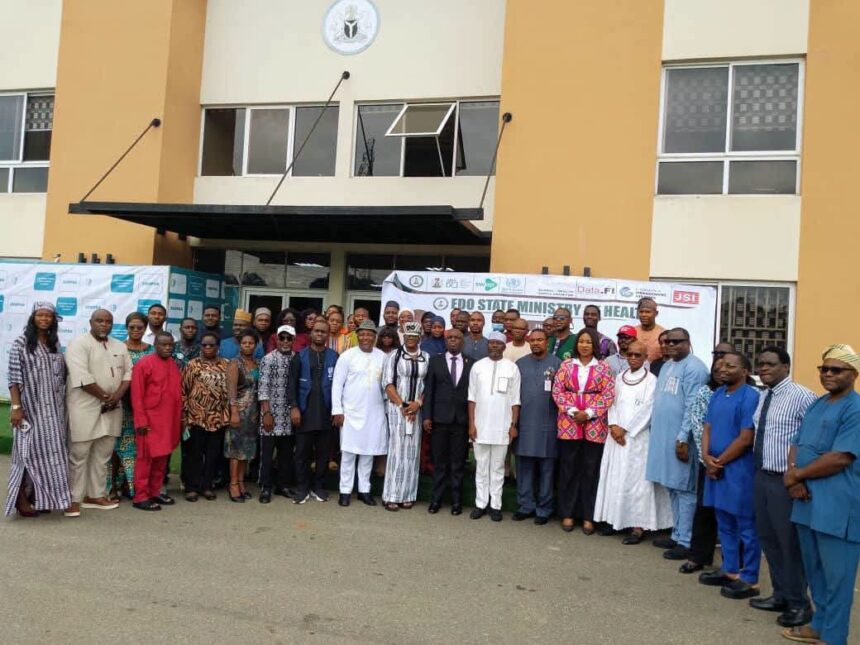
The Edo State Government has reaffirmed its commitment to building a more resilient healthcare system by promoting transparency, accountability, evidence-based planning, and strategic partnerships aimed at achieving Universal Health Coverage (UHC).
The assurance was given by the State Commissioner for Health, Dr. Cyril Adams Oshiomhole, while declaring open the 2026 Edo State Universal Health Coverage Joint Annual Review (JAR) in Benin City on behalf of Governor Monday Okpebholo.
Dr. Oshiomhole conveyed the governor’s appreciation to development partners, healthcare professionals, local government officials, traditional institutions, community representatives, and other stakeholders for their unwavering support in improving healthcare delivery across the state. He said their participation reflected a shared commitment to ensuring quality, accessible, and affordable healthcare for every Edo resident.
Describing the Joint Annual Review as one of the state’s foremost health sector accountability mechanisms, the commissioner noted that the exercise provides an opportunity for government, development partners, healthcare providers, local government authorities, communities, and the private sector to evaluate health sector performance, review progress, identify gaps, and develop practical strategies for strengthening healthcare services.
He urged participants to engage in meaningful discussions, share innovative ideas and best practices, and make recommendations that would further improve health outcomes and accelerate the state’s journey toward Universal Health Coverage.
Representatives of the Federal Ministry of Health and Social Welfare, the World Health Organization (WHO), the Global Health Supply Chain–Procurement and Supply Management (GHSC-PSM) Project, and the Corona Management System Team commended the Edo State Government for convening the review, describing it as a vital platform for strengthening accountability, fostering collaboration, and driving continuous improvements in healthcare delivery.
Earlier, the Director of Planning at the Edo State Ministry of Health, Mrs. Iruobe Lauretta, described the Joint Annual Review as a strategic platform for assessing health sector performance, evaluating programme implementation, and strengthening collaboration among stakeholders. She expressed confidence that the 2026 review would produce actionable recommendations to enhance service delivery and support the state’s vision of providing accessible, affordable, and quality healthcare to all residents.
Technical sessions highlighted progress and challenges across key public health programmes.
Presenting the Routine Immunisation Programme, Dr. Sonia Aimiehinon Balogun said the initiative provides protection against vaccine-preventable diseases, including tuberculosis, polio, measles-rubella, yellow fever, rotavirus, and Human Papillomavirus (HPV). She disclosed that the programme is prioritising zero-dose children and aims to achieve at least 90 per cent coverage for Pentavalent 3 and Measles-Rubella vaccines across all 18 local government areas by December 2026.
Speaking on tuberculosis control, Mr. Okhuoya Onomen said the National Tuberculosis, Buruli Ulcer and Leprosy Control Programme continues to provide free diagnosis and treatment, community sensitisation, contact tracing, and Tuberculosis Preventive Therapy (TPT) in line with national strategies to reduce the burden of the disease.
Officials of the malaria control programme highlighted ongoing efforts to strengthen malaria prevention, improve diagnosis and treatment, prevent malaria in pregnancy, expand the distribution and use of Long-Lasting Insecticidal Nets (LLINs), and improve case management through stronger health information systems. Although they acknowledged challenges such as periodic shortages of malaria commodities and insecurity in some communities, they noted significant improvements in malaria prevention and treatment during the 2026 review period and called for intensified efforts to increase LLIN coverage and uptake of Intermittent Preventive Treatment in Pregnancy (IPTp).
The State AIDS and Sexually Transmitted Infections Control Programme (SASCP), represented by Mr. Armstrong Wazil Atebor, said the programme is strengthening Edo State’s response to HIV, viral hepatitis, and sexually transmitted infections by expanding access to integrated healthcare services and antiretroviral therapy, particularly for pregnant women, children, and other vulnerable populations.
Also speaking, Dr. Oghenekaro Onoriose described Non-Communicable Diseases (NCDs) as a growing public health concern responsible for about 30 per cent of deaths in Nigeria. He revealed that more than 850 residents had been screened through community-based interventions in 2026, while free weekly screening for hypertension and diabetes had been introduced to promote early diagnosis, timely treatment, and healthier lifestyles.
The 2026 Joint Annual Review is expected to generate practical recommendations that will strengthen Edo State’s healthcare system, improve service delivery, and advance the government’s goal of achieving Universal Health Coverage.
Credit:Edo State government/Judith Ipogah