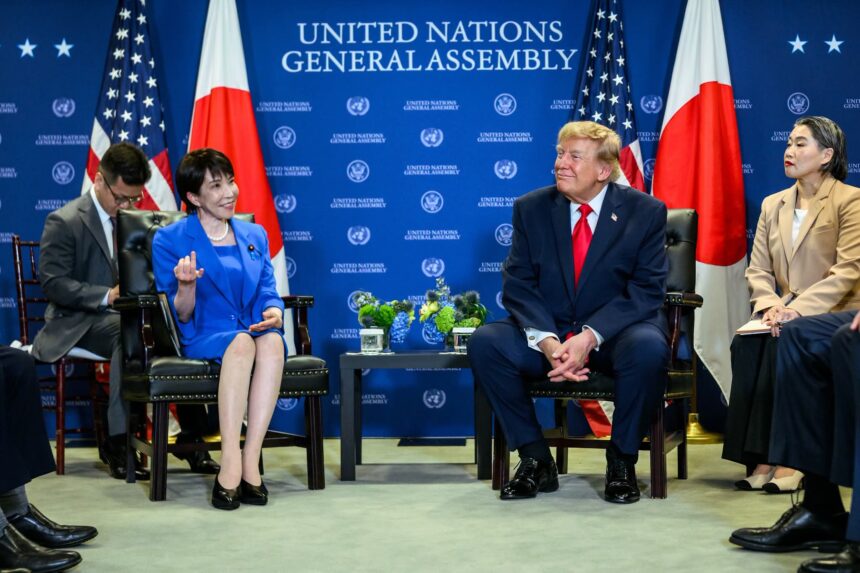
US President Donald Trump and Japanese Prime Minister Sanae Takaichi have reaffirmed their commitment to strengthening the US-Japan alliance, with economic security, advanced technology and regional security dominating their discussions on the sidelines of the United Nations General Assembly in New York.
Trump and Takaichi met on Tuesday, September 22, 2026, in a 35-minute bilateral meeting during the 81st session of the UN General Assembly. The White House confirmed the meeting, while Japan’s Prime Minister’s Office said both leaders agreed to further strengthen cooperation in economic security, the economy and defence.
According to the Japanese government, the two leaders specifically discussed cooperation in artificial intelligence, semiconductors and critical minerals, with both sides agreeing to deepen efforts aimed at strengthening technological competitiveness and supply-chain resilience.
They also reaffirmed the importance of implementing the existing US-Japan tariff agreement and discussed ways to further advance economic cooperation between the two countries.
On security, Trump and Takaichi agreed to strengthen the alliance’s deterrence and response capabilities, which Tokyo described as important to peace and prosperity in the Indo-Pacific region.
The meeting also took place shortly before Trump’s talks with Chinese President Xi Jinping, giving the discussions an added geopolitical dimension. The two leaders exchanged views on China and agreed to maintain close coordination on issues involving economic security and the wider Indo-Pacific.
They also discussed North Korea’s nuclear and missile programmes, reaffirming the need for continued cooperation. Takaichi said she received Trump’s support for Japan’s efforts to resolve the issue of Japanese citizens abducted by North Korea.
Trump, speaking during the meeting, praised Takaichi and described her as a highly respected Japanese prime minister. He also commended what he described as improvements in Japan’s economy and said he expected her to become “one of the great prime ministers.”
Political implications
The meeting reinforces Washington and Tokyo’s efforts to present a coordinated position on security and economic challenges in the Indo-Pacific. Japan’s official account indicates that both governments intend to work more closely on China-related economic security, technological competition and regional deterrence.
The timing is also significant because the talks came just before Trump’s scheduled engagement with Xi. Japan has an interest in ensuring that its security concerns remain part of Washington’s broader China policy, particularly amid competition over technology, supply chains and regional security.
Economic implications
The emphasis on AI, semiconductors and critical minerals reflects the growing economic-security dimension of US-Japan relations. Both countries depend on resilient supply chains for advanced technologies and strategic materials, making cooperation in these areas important for their manufacturing and technology sectors.
Closer coordination could encourage investment and joint development in strategic industries while reducing exposure to supply disruptions. However, the practical economic impact will depend on how the agreements and tariff arrangements discussed by the two leaders are implemented.
The meeting also highlights the broader shift in US-Japan relations from a traditional security alliance towards a partnership encompassing technology, trade, critical minerals and industrial resilience.
The discussions have drawn varied reactions online, ranging from praise for the strengthening of the US-Japan alliance to criticism and political commentary about Trump’s diplomacy. Other reactions have focused on the wider human cost of geopolitical tensions, with calls for world leaders to prioritise dialogue and peace over conflict.
For Washington and Tokyo, however, the New York meeting underscored a shared effort to deepen their alliance at a time of heightened strategic competition in the Indo-Pacific.