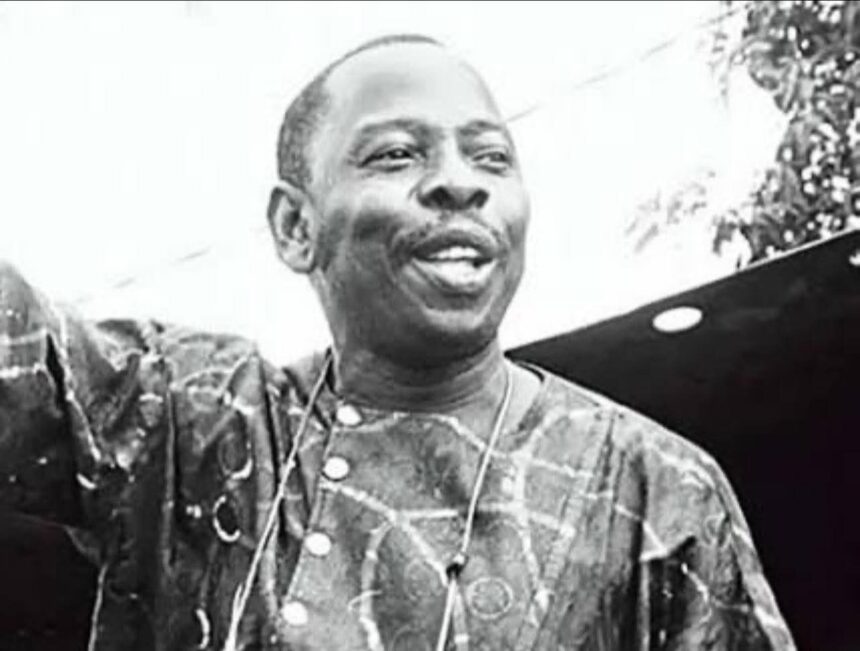
Kenule Beeson Saro Wiwa, born on 10 October 1941 in Bori near Port Harcourt, was a Nigerian writer, teacher, television producer, businessman, and one of Africa’s most influential human rights and environmental activists. He was a son of Chief Jim Wiwa, a forest ranger and traditional title holder in Ogoniland, and Widu, his father’s third wife. After the Nigerian Civil War, he formally adopted the name Saro Wiwa. He was married to Maria Saro Wiwa and was a member of the Ogoni people, a small ethnic minority in the Niger Delta whose homeland became a major centre of crude oil extraction from the 1950s onward. Decades of oil exploration left Ogoniland environmentally devastated through oil spills, gas flaring, and indiscriminate dumping of petroleum waste.
Saro Wiwa was raised in an Anglican household and showed academic brilliance from an early age. He attended a Native Authority primary school in Bori and later Government College Umuahia, where he distinguished himself as a student, won prizes in History and English, and captained the school’s table tennis team. He earned a scholarship to study English at the University of Ibadan, where his intellectual and cultural interests flourished. During his years at Ibadan, he won departmental prizes in 1963 and 1965 and became actively involved in theatre, performing with a travelling drama troupe across Kano, Benin, Ilorin, and Lagos, while also collaborating with the Nottingham Playhouse theatre group.
After graduation, Saro Wiwa briefly worked as a teaching assistant at the University of Lagos and later as a lecturer in African literature at the University of Nigeria, Nsukka. His academic career was interrupted by the outbreak of the Nigerian Civil War in 1967. As a supporter of the Federal Government, he was forced to leave the Eastern Region and return to Ogoniland. On his journey, he witnessed large numbers of displaced civilians fleeing the conflict, a sight he later described with deep sorrow. Shortly after his arrival in Bonny, the town fell to federal troops. While his family remained there, he returned to Lagos to resume work at the University of Lagos. He was soon recalled to Bonny, however, where he was appointed Civilian Administrator of the strategic port city.
During the civil war, Saro Wiwa emerged as a prominent Ogoni leader aligned with the federal cause. After the war, he served as a commissioner in the former Rivers State government. His experiences during the conflict deeply influenced his literary output. His novel Sozaboy: A Novel in Rotten English, published in 1985, presents the story of a naïve village boy conscripted into the army and offers a powerful critique of war, corruption, and military rule in Nigeria. His war diaries, later published as On a Darkling Plain in 1989, provide a personal and reflective account of the conflict.
In the early 1970s, Saro Wiwa was appointed Regional Commissioner for Education in Rivers State. His tenure ended in 1973 after he openly supported greater political autonomy for the Ogoni people. Beyond politics, he achieved remarkable success in business and broadcasting. His television series Basi and Company became one of Nigeria’s most popular programmes, attracting an estimated audience of over 30 million viewers. The satirical show portrayed urban life through humour and social critique and ran from 1985 to 1990. By the late 1970s, Saro Wiwa had also established profitable ventures in retail and real estate, though in the 1980s he increasingly focused on writing, journalism, and media production.
Saro Wiwa’s engagement with national politics continued intermittently. In 1977, he contested for a seat representing Ogoni in the Constituent Assembly but narrowly lost. In 1987, he was appointed by the military government of General Ibrahim Babangida to assist in Nigeria’s transition to civilian rule. He later resigned in protest, convinced that the transition programme lacked sincerity. His doubts proved justified when Babangida annulled the 1993 general elections, plunging the country into political crisis.
From 1990, Saro Wiwa devoted himself almost entirely to environmental and human rights activism. He became a leading figure in the Movement for the Survival of the Ogoni People, eventually serving as its president. Under his leadership, MOSOP articulated the Ogoni Bill of Rights, which demanded political autonomy, a fair share of oil revenues, and remediation of environmental damage. The movement drew international attention to the destructive impact of oil operations, particularly those of Royal Dutch Shell, and criticised the Nigerian government for failing to enforce environmental regulations.
In January 1993, MOSOP organised peaceful marches involving approximately 300,000 Ogoni people, more than half of the population. Later that year, the Nigerian government militarised Ogoniland, and Saro Wiwa was detained without trial for several months. Between 1993 and 1995, he also served as Vice Chairman of the General Assembly of the Unrepresented Nations and Peoples Organization, an international body advocating for indigenous and marginalised peoples.
On 21 May 1994, four Ogoni chiefs were murdered during a period of internal division within MOSOP. Although Saro Wiwa had been barred from entering Ogoniland on the day of the killings, he was arrested and accused of inciting the murders. He denied the charges but was detained for over a year. Along with eight other Ogoni leaders, later known as the Ogoni Nine, he was tried by a special military tribunal widely condemned for lack of due process. Several defence lawyers withdrew in protest, and key witnesses later admitted they had been bribed to testify against the accused.
Despite international appeals, the military government of General Sani Abacha upheld the death sentences on 8 November 1995. On 10 November 1995, Ken Saro Wiwa and the other eight activists were executed by hanging at Port Harcourt Prison. His execution provoked global outrage and led to Nigeria’s suspension from the Commonwealth of Nations. Governments, international organisations, and human rights groups condemned the killings, imposed sanctions, and recalled diplomatic representatives.
Saro Wiwa’s death marked a turning point in the global business and human rights movement. In subsequent years, legal actions were brought against Royal Dutch Shell in United States courts under international human rights statutes. In 2009, Shell agreed to a settlement of 15.5 million dollars with the families of the Ogoni Nine, while denying legal liability.
In 2017, the Ken Saro Wiwa Foundation was established to support access to basic infrastructure and promote entrepreneurship in Port Harcourt. His legacy has also been honoured through memorials, awards, music, literature, and documentaries. Streets, institutions, and even biological species have been named after him. On 12 June 2025, Ken Saro Wiwa and the other members of the Ogoni Nine were granted a posthumous pardon by President Bola Ahmed Tinubu.
Ken Saro Wiwa remains a symbol of moral courage, intellectual resistance, and the struggle for environmental justice in Africa. His life and death continue to resonate as a powerful reminder of the human cost of resource exploitation and authoritarian rule.
Credit: Northern History